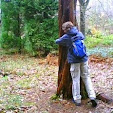
Another jaunt into Heath Bank Woods tonight, just as an antidote to three days straight in the office. I was studying recently about spiritual attachments to trees and forests, and how forests - even if not pristine - still represent nature, wilderness, and simplicity in contrast to our frantic and artificial modern lifestyles.
A few oak trees were too tempting not to climb, the first proper tree climbing this year. I climb trees way more now than I ever did when I was younger. There were no ropes, so climbing was both more liberated and more constrained at the same time. Sitting up in the top of the trees the wind could be felt more keenly, and it was easy to become half-lulled by the swaying.
Down near the stream is a notable old oak, hollowing out at the base. Last year I found this just a week or two too late - there were prolific chicken-of-the-woods fruiting in it, but just a bit too past it. In the winter they had turned white and rubbery, and for now only white patches of mycelia remained visible. There has, in the not-too-distant-past, been a fire in the base, and the inner wood is charred and blackened. You could stand in it, a bit of a squeeze and putting your head up into the dark, unopened upper part of the cavity, but you can still do it. The wood around the hollow is slowly buckling under the weight of the tree, but I reckon it still has plenty of years left. I drew my friend an old pirate-style map so he could find the tree and hopefully a bountiful fungus crop too.
Following a small track past the tree takes you down to the stream, and another oak only metres away has a lower bough comfortable enough to perch on. The wild garlic was in flower prolifically, and bluebells, ferns and other flora were carpeting the floor. The trickle of the stream was the only sound. I know that the wood is hardly 'untouched' - there are public footpaths, albeit rough ones, as well as occasional dog walkers and evidence of camping. Even the big hollowing oak has been touched - fire charring and graffiti on the decaying wood. But even so, it is nice to feel like you're in "the wilds". I suppose it's the so-called shifting baseline of what is considered 'natural' to each generation, as the world becomes more and more altered.
It doesn't matter what analysis of historic land use and present influence you apply though. It's interesting to look for features of old influence, and to consider why some features are the way they are. But on the other hand my phone had run out of battery and I'd left my watch at home, so I sat there without any knowledge of how much time was spent there, just listening to the running water, feeling the moss on the tree, pondering and tuning out. It might not have been true wilderness, but it still felt natural.
About Me
- Treecological
- Cumbria, United Kingdom
- A forester, naturalist and environmentalist.
Thursday, 21 May 2015

Thursday, 30 October 2014
Talking the talk
Recently at work, I did a Picus on a veteran Ash tree on behalf of someone else's project. This was in the same week that I was talking to my boss (a high-up figure in the Arb Consultancy industry), who was proclaiming enthusiastically that he'd been talking to some other equally high-up consultant about the necessity to preserve veteran trees at the recent Arb Association conference. The Picus revealed about 50% hollowing from a major limb loss, so I recommended gradual reduction works, phased over a period of years.
The project was a development one, so I called the client just to explain what I had found. I was told this was a big problem, because the tree 'needed' to go to build a road into a new housing development. It appears that this road apparently over-ruled a 200 year old living organism. Anyway, I passed the buck, saying that I just did the Picus, those were my recommendations, but its not my project.
I then saw - by chance - an e-mail from my boss to these developers, saying that whilst the Picus couldn't be used to immediately justify felling for safety purposes, it could be used to indicate 'limited long-term usefulness' and so could justify removal for development. As a reminder, this is the same boss who stood there at an industry conference extolling the virtues of veteran trees. This is the same person who puts up, on linkedin and twitter and the like, endless posts about the importance of trees and the need to preserve them.
Now I hear that the council - rightly - put TPOs on the trees, and my company are supporting an objection to the TPOs.
This illustrates a massive flaw in the arb industry. Everyone talks the talk, claims to be an environmentalist, turns up at industry conferences and give speeches about how we must do more to protect our trees, integrate them into urban environments, "green the cities". But, when it comes to clients telling us what to do in light of their development (in itself, making a mockery of the British Standard for development in relation to trees), all that green-talk goes out of the window. No-one has a backbone to stand by their proclamations. I don't know if that's because people don't really believe it, or if (as I suspect) people are too scared of losing business to someone who will compromise.
If it's the latter case, then what the industry needs, as a whole, is to tighten up its ethical code. If you don't bend to a client's will, of course they're going to go to someone who will - and, since everyone is playing the game, there is always someone. However, if arboricultural consultants care about trees half as much as they publicise that they do, then if the industry united, tightened up, and advised, honestly and independently, instead of doing what clients tell them to do - then developers aren't going to go anywhere else, because every consultant will say it as it is, not what clients want. Then, the industry will truly be doing what it pretends at the moment to be doing - properly advising and caring for trees.
Perhaps this needs the help of tree officers; at the end of the day, tree officers are all too often suspicious of consultants' motives (not without reason), whereas really we should all work together for the sake of what we (claim to?) believe in. Consultants advise, out of belief and passion for tree preservation; tree officers support it, through enforcement; and developers can't get what they want, when they want. Any consultants who do bend to the whim of their clients are quickly caught out by local authorities.
Sadly though, it will take some brave (and honest) people to stand up for what they believe in, in the face of losing business. However, if the industry is going to pat itself on the back and talk the environmental talk, then everyone should really start walking the walk - together.
The project was a development one, so I called the client just to explain what I had found. I was told this was a big problem, because the tree 'needed' to go to build a road into a new housing development. It appears that this road apparently over-ruled a 200 year old living organism. Anyway, I passed the buck, saying that I just did the Picus, those were my recommendations, but its not my project.
I then saw - by chance - an e-mail from my boss to these developers, saying that whilst the Picus couldn't be used to immediately justify felling for safety purposes, it could be used to indicate 'limited long-term usefulness' and so could justify removal for development. As a reminder, this is the same boss who stood there at an industry conference extolling the virtues of veteran trees. This is the same person who puts up, on linkedin and twitter and the like, endless posts about the importance of trees and the need to preserve them.
Now I hear that the council - rightly - put TPOs on the trees, and my company are supporting an objection to the TPOs.
This illustrates a massive flaw in the arb industry. Everyone talks the talk, claims to be an environmentalist, turns up at industry conferences and give speeches about how we must do more to protect our trees, integrate them into urban environments, "green the cities". But, when it comes to clients telling us what to do in light of their development (in itself, making a mockery of the British Standard for development in relation to trees), all that green-talk goes out of the window. No-one has a backbone to stand by their proclamations. I don't know if that's because people don't really believe it, or if (as I suspect) people are too scared of losing business to someone who will compromise.
If it's the latter case, then what the industry needs, as a whole, is to tighten up its ethical code. If you don't bend to a client's will, of course they're going to go to someone who will - and, since everyone is playing the game, there is always someone. However, if arboricultural consultants care about trees half as much as they publicise that they do, then if the industry united, tightened up, and advised, honestly and independently, instead of doing what clients tell them to do - then developers aren't going to go anywhere else, because every consultant will say it as it is, not what clients want. Then, the industry will truly be doing what it pretends at the moment to be doing - properly advising and caring for trees.
Perhaps this needs the help of tree officers; at the end of the day, tree officers are all too often suspicious of consultants' motives (not without reason), whereas really we should all work together for the sake of what we (claim to?) believe in. Consultants advise, out of belief and passion for tree preservation; tree officers support it, through enforcement; and developers can't get what they want, when they want. Any consultants who do bend to the whim of their clients are quickly caught out by local authorities.
Sadly though, it will take some brave (and honest) people to stand up for what they believe in, in the face of losing business. However, if the industry is going to pat itself on the back and talk the environmental talk, then everyone should really start walking the walk - together.
Tuesday, 22 July 2014
A civilised society
Civilisation.
Where forests - carbon sinks, oxygen sources, habitat, water regulation, firewood, medicinal plants, huge biodiversity - are felled in huge swarths to provide bare land for building, or growing crops or animal feed.
Where we've "moved on" from eating edible plants to selecting vast monocultures of crops to grow. Where the soils have been depleted and natural resistance eroded, so we apply sticking plasters of toxic fertilisers and pesticides to prop it up for one extra season at a time. Where the natural balance of variation, and its benefits not only for biodiversity but also for food production, are ignored.
Where, to grow our crops, we remove trees that would provide alternative food sources, shade, natural soil binding and nutrients, and firewood for fuel. Where our soil, now empty and near-lifeless, washes into rivers.
Where we want driveways for our cars, or paved areas so we don't have to cut the grass, and so we pave over the soil. We cover the ground, and then bemoan the flooding that ensues. The flooding that is already worsened by the removal of riparian woodlands, and of wetlands that should be slowing the water rushing down the rivers.
Where conservation of the natural world, and all that it gives, has to fit in with the economy. Where we should be grateful for people "compromising", and leaving a bit of greenery whilst the rest is destroyed in pursuit of profit.
Where the belief is that everyone makes money and everyone's happy. Everyone can buy bigger houses, more material goods, flasher cars, and no-one loses. Well, only those people in sweatshops making the material goods. Only the environment, resources plundered to produce raw materials for goods. But that's irrelevant, as long as the money keeps flooding in.
Where its more important to 'fix the economy' and push the green agenda down in importance - it's all good to make vague promises about carbon reductions, but that's second place to making more money. All hail this artificial construct of the economy, of the stock market, of "the markets" that seem to rule all of human society. They're not even real, yet we worship them above all else.
Where we drive to work, drive home, shop at supermarkets, eat food of questionable origin, whilst we forget about who lives around us. Where we know more about what goes on in social media than we do about our neighbours' lives. We forget that our meat was once an animal, often maltreated and suffering before being slaughtered just for us.
Where we turn a blind eye to everything collapsing around us, and carry on as normal - make money, consume, repeat. Where we ignore the warning bells of a world pushed to the limit by our selfish, greed-driven behaviour.
Where corporations - businesses, mere businesses - now have the power to sue entire countries if they won't allow resource exploitation on their land
Sometimes it's hard to feel positive about 'civilisation'. I feel like we've taken a wrong turning somewhere.
Where forests - carbon sinks, oxygen sources, habitat, water regulation, firewood, medicinal plants, huge biodiversity - are felled in huge swarths to provide bare land for building, or growing crops or animal feed.
Where we've "moved on" from eating edible plants to selecting vast monocultures of crops to grow. Where the soils have been depleted and natural resistance eroded, so we apply sticking plasters of toxic fertilisers and pesticides to prop it up for one extra season at a time. Where the natural balance of variation, and its benefits not only for biodiversity but also for food production, are ignored.
Where, to grow our crops, we remove trees that would provide alternative food sources, shade, natural soil binding and nutrients, and firewood for fuel. Where our soil, now empty and near-lifeless, washes into rivers.
Where we want driveways for our cars, or paved areas so we don't have to cut the grass, and so we pave over the soil. We cover the ground, and then bemoan the flooding that ensues. The flooding that is already worsened by the removal of riparian woodlands, and of wetlands that should be slowing the water rushing down the rivers.
Where conservation of the natural world, and all that it gives, has to fit in with the economy. Where we should be grateful for people "compromising", and leaving a bit of greenery whilst the rest is destroyed in pursuit of profit.
Where the belief is that everyone makes money and everyone's happy. Everyone can buy bigger houses, more material goods, flasher cars, and no-one loses. Well, only those people in sweatshops making the material goods. Only the environment, resources plundered to produce raw materials for goods. But that's irrelevant, as long as the money keeps flooding in.
Where its more important to 'fix the economy' and push the green agenda down in importance - it's all good to make vague promises about carbon reductions, but that's second place to making more money. All hail this artificial construct of the economy, of the stock market, of "the markets" that seem to rule all of human society. They're not even real, yet we worship them above all else.
Where we drive to work, drive home, shop at supermarkets, eat food of questionable origin, whilst we forget about who lives around us. Where we know more about what goes on in social media than we do about our neighbours' lives. We forget that our meat was once an animal, often maltreated and suffering before being slaughtered just for us.
Where we turn a blind eye to everything collapsing around us, and carry on as normal - make money, consume, repeat. Where we ignore the warning bells of a world pushed to the limit by our selfish, greed-driven behaviour.
Where corporations - businesses, mere businesses - now have the power to sue entire countries if they won't allow resource exploitation on their land
Sometimes it's hard to feel positive about 'civilisation'. I feel like we've taken a wrong turning somewhere.
Monday, 7 July 2014
BCEP in the woods
An environmental charity that my friend works for have recently taken over management of an urban woodland in Bradford, and he asked me if I'd be willing to do a bit of volunteering to help with the practical side of the woodland management. I must admit to missing the sunny days out in the woods and so happily said yes. So far, I've spent a couple of days there this summer, carving a fallen sycamore into a play feature for children and thinning out some dense sycamore over the footpath, to make it less gloomy and foreboding.


Also spent a while thinning an area dominated by birch, where the charity hope to create a forest schools area for local pupils.
There's still work to be done, and more thinning, but it's a nice project to be involved in and a way to hopefully utilise a slightly neglected and overlooked woodland.
 |
| Partway through, with "steps up" made along one co-dominant stem |
 |
| A probable factor in the tree falling? Dryad Saddle fruiting on the stump |
 |
| Criss-cross cuts to make it less slippery |
 |
| The finished piece... |
 |
| Before... |
 |
| ...after |
 |
| In a geeky way, I find something so aesthetically pleasing about birch logs! |
There's still work to be done, and more thinning, but it's a nice project to be involved in and a way to hopefully utilise a slightly neglected and overlooked woodland.
Wednesday, 2 July 2014
New discoveries
A handful of more unusual trees that I've seen over the past wee while, mostly from Sheffield Botanic Gardens.
Cyprus cedar (Cedrus brevifolia) - a bit like an Atlas cedar, but with super small needles:

A strawberry tree (Arbutus unedo) - after seeing this, I recognised another on the same street as my girlfriend's house:


A purple-leaved variety of Katsura (Cercidophyllum japonicum), one of my favourite trees due to its lovely, caramel smell in autumn. I think the variety may be 'Red Fox'?

Styrax japonicum - a snowdrop tree:

Whilst it is a native tree, I don't think I've ever seen a wild service tree (Sorbus torminalis) outside of collections. The craggy, patchwork brown and grey bark is lovely.


And, from Paignton Zoo in Devon, a cork oak (Quercus suber):


Finally, mulberry trees (Morus nigra) must be like buses - been looking for ages, and then have seen three this year. Even ran around one of them.


Sunday, 15 June 2014
A walk in the woods
Walking along Slades Road, the first footpath sign seems to point into someone's garden; a neat metal fence, with cars parked beyond it. The footpath further along is blocked by curious cows, so it's back to the first and cutting through someone's drive, feeling guilty even despite the Public Footpath fingerpost.

Walk a bit further, and I come to a gated junction. To the left, back to Colne Valley. The cheers and shouts of a crowd as someone far away in Brazil scores, or doesn't score, reinforces the decision to turn right and head further into the woods. A little way in and a trail heads off steeply downhill, too tempting to ignore. Here, the oaks are contorted, squat and buckled, but no less lovely than those larger, open-grown trees you might see in a hedgerow.


Past the stables and recent balsam clearance, and now I'm into Heath House Woods. Well, above it. The recent rain has freshened everything up, and this path cuts along the upper edge, bordered by young oaks, Sorbus, hawthorn, and other edge species. A first swig of Bowmore here (unashamedly inspired by Robert Macfarlane's whisky-fuelled strolls), whilst looking out above the woodland canopy of oaks that carpet the valley. It looks almost as though you could walk across to Heath House on top of these crowns.
Walk a bit further, and I come to a gated junction. To the left, back to Colne Valley. The cheers and shouts of a crowd as someone far away in Brazil scores, or doesn't score, reinforces the decision to turn right and head further into the woods. A little way in and a trail heads off steeply downhill, too tempting to ignore. Here, the oaks are contorted, squat and buckled, but no less lovely than those larger, open-grown trees you might see in a hedgerow.
A magpie flies through the canopy. One for sorrow. The grasses and brambles are laden with cuckoo spit, I don't know if I've ever seen more in one spot. Finally, another magpie joins the first. Two for joy - a far more optimistic prospect. A roaring in the distance sounds like a waterfall, although it is just as likely to be a mill or even some machinery somewhere. However, the babbling of a beck at the bottom of the slope is unmistakable, and so I head down. On the way, wonder about the wood's history. Planted, or a remnant of what used to be? Worked, and by whom, and why? And does that even matter, or should we just enjoy wondering in woods, rather than analyse them?
A tyre swing and further tyres making up stepping stones by no means detract from the strength of the oak on the opposite bank, which must have stood sentinel by the beck for a century at least. However, as well intentioned as the tyres may be, they still remind of the uncomfortable proximity of the town to the left. So across the burn a turn right, heading up past a decaying log. The tree must have fallen naturally, but the clean cuts and branch stubs show that at least once someone has been in here with a saw.
Following the beck upstream, it forks into two. Each of the gulleys along which it heads are lush and green; it might not be as vast, stirring, symbolic or emotive as the Amazon, but these oak woodlands are our temperate rainforests. And the lichens on branches, the fungi and ground fauna, the birds calling still demonstrate the diversity of these woods. A jay flits across the beck and alights on a branch, silhouetted and quieter than its rowdier, black and white cousins.
I cross back over the beck and head upwards, slipping on the wet mud, finally reaching a defined path cutting across perpendicular. A squat oak here offers two nice boughs for a seat and so I sit for a while, taking a few swigs and enjoying the sound of water, whilst admiring the fresh pink on newly flushed epicormic growths.
Further on, I come to a bridge crossed on a previous stroll, and realise that this path leads out, eventually, to the cows. So an about turn, and taking a left fork that eventually leads out to a more widely spaced area. I've been here before, taking a seat in an oak in the sun and whimsically fantasising about building a hut here, leaving civilisation as we know it to live in the woods. I had begun to plan it out - planting edible plants, thinking of water sources - a beautiful distraction from our everyday lives.
Back up to that gated junction, following the track out to find a large house and grounds. Someone with the money to buy a lovely patch of land, but without the sense to take only what they need from it. It's hard to ignore the urge to head back now, back into the woods. and so that's what I do; picking up that original path out. Halfway along, a small track leads down, again too intriguing not to followed. It ends up leading out to an oak begging to be climbed; dropping towards it, and it become apparent this is the top of my imagined woodland settlement. Oh, well. Climb the tree, a couple more swigs, listen to chaffinches piping alarm. Savour the greenery, the stillness, the simplicity. Then back out to the path, to someone's garden, and finally to tarmac once more.
Wednesday, 21 May 2014
Ulterior motives, realised
Having done
the Picus test on the beech tree I blogged about below, and submitted a report
recommending a 20% crown reduction, cable bracing and rhizosphere improvement,
I felt like I had done the best for that tree. I know the clients weren’t happy
with it, thanks to the phone call from the developer (!) acting on their
behalf, but felt that I had proved the tree could be retained and made safe.
However,
things change. The wife living at the house called me up. First argument – that
Ganoderma could be putting out spores
attacking all the trees in their garden, including another big beech recently
pruned. I explained how, as soon as a cut is made, hundreds of spores of all
kinds of organisms will be landing on that wood; removing this beech and its Ganoderma will not stop infection. Her
second line of attack rattled me more – an emotionally manipulative argument,
discussing the tree falling on her and/or her family, killing her children. She
had ‘found out’ that I would be liable for such actions, if the tree failed
after I made my recommendations.
Although I
knew this, and told her as much, I still went away that night worrying. What if
I have made the wrong decision? What if it does fail, and I’m in court faced
with negligence or manslaughter? However, I managed to settle myself down –
other, experienced consultants proof-read my report and looked at the Picus
results, and reached the same conclusion I had.
I naively hoped that would be it – if they did the work I recommended then
their fears for safety would be alleviated.
Apparently not,
since it was the husband’s turn last night. He gave me all kinds of bulls**t.
They can’t insure for their house, given that cable bracing “is using giant
bungees to hold a limb up when it fails”. No,
it’s not; it reduces loading on a potential weak point, to prevent failure. Their neighbours
are signing a petition to fell the tree because he’s been scaremongering about
how dangerous it is. Did he tell them
that my report had made recommendations that would reduce risk to an acceptable
level? It’s got no long-term future, felling it would be euthanasia. Sorry,
but no. Euthanasia is mercy killing; the
tree is not suffering, the problem’s with him perceiving it to be in the
way.
And, the
closest he admitted to wanting it out the way for reasons other than safety –
he’s spending £40,000 re-landscaping his garden, and doesn’t want that trashed “in
a year’s time” by “a crane coming in” to fell the tree. Firstly – the tree
could last far longer than a year. And secondly, well, there’s the reason for
wanting rid – a tree with 150cm dbh has the maximum root protection area of 15m,
that’s a big area on which our poor client can’t alter levels or put in garish
garden features.
So, this
morning, I sent a very considered and careful e-mail, putting in writing about
what “an acceptable level of risk” means, about how cable bracing works, about
the relative strength of Ganoderma (quoting
an excerpt from Lonsdale’s Principles of
Tree Hazard Assessment and Management, on how trees can sit with this
fungus for many years without compromising safety). I reiterated the tree’s
benefits – amenity and historic value, wildlife benefits, pollution
attenuation, evaporative cooling, shading, and reducing waterlogging in his
precious garden. I also explained the council see all these positives, as
demonstrated by the protective order.
His
response? They’re applying to fell the tree, “because it is dangerous”. They’ve
hired an Arb Association approved consultant (what, like the company I work
for?) to “review” my report and support felling the tree.
I don’t
know whether I am more angry or upset. I had a tear in my eye. Firstly – I’ve
failed trying to save a significant, majestic, wonderful being that can easily
be made safe but kept. It’s down to the tree officer now, who (if these guys
are as underhand as I suspect) may never see my report. I hope their new
consultant recommends my work; but what if they care less about morals and integrity,
and support the felling. I’ve tried, really bloody tried, to help save a being
far older than any of us involved – and failed.
I honestly get upset about this kind of thing. Trees aren't inanimate objects in our landscape; they are living, respiring, growing organisms. The ecosystem services they provide far outweigh the minor ways in which we, as humans, should be altering our lifestyles to co-exist with them. This tree was at least 150 years old, possibly more. There is no way, morally, killing it can be justified when with some sympathetic treatment it could live for decades longer. It is truly heartbreaking to think that this tree could soon be felled - killed - because of selfish and greedy owners of the land on which it stands.
I honestly get upset about this kind of thing. Trees aren't inanimate objects in our landscape; they are living, respiring, growing organisms. The ecosystem services they provide far outweigh the minor ways in which we, as humans, should be altering our lifestyles to co-exist with them. This tree was at least 150 years old, possibly more. There is no way, morally, killing it can be justified when with some sympathetic treatment it could live for decades longer. It is truly heartbreaking to think that this tree could soon be felled - killed - because of selfish and greedy owners of the land on which it stands.
Secondly –
I’m angry. Bitterly angry. Angry about the emotional manipulation to try and
sway my decision. Angry about these ill-informed, greedy homeowners ignoring my
advice because it’s not what they wanted – even though it was for the good of
the tree, good of the environment, and even would have benefitted their
property. Angry that they want to undermine my findings because I was too professional
to side with them on this. Angry that they own a beautiful house made even
better by a beautiful beech tree – I cannot overstate how significant it is. If
you don’t like trees, don’t buy the house with them; go live with your sterile
strip of lawn, and fancy landscaped features. I’d happily live under that tree,
Ganoderma and all.
Another
case of money being more important than anything else – and my crushing
realisation that I can do nothing about it. Is this what consultancy is going
to be like?
Subscribe to:
Posts (Atom)