About Me

My photo
Cumbria, United Kingdom
A forester, naturalist and environmentalist.

Sunday, 4 March 2018

What exactly is "stewardship"?

As hinted at in the last post, I've been thinking a lot recently about our subsidy system - what it delivers and what it doesn't, and ultimately, how fair it is it.

Part of this is inspired by walking around the Lakes landscape, where "Higher Level Stewardship" schemes (and the newer Countryside Stewardship schemes) are visible in areas where sheep numbers are reduced, trees and shrubs are planted, and cattle-only grazing can be seen being implemented.

On the one hand, the results are positive - for example, cattle-only grazing in various areas is resulting in a scrubbier landscape developing, hopefully in time with more tree regeneration following and undoubtedly an increase in biodiversity, soil health and hydrological functioning.


However, I'm finding the motives being higher-level payments is often fairly sickening.

Firstly, it's a bribe. Our landowners - or, as can often happen, tenants holding the power over landowners - will get a 'basic' payment to farm the land. This means that every field corner, every square metre, is financially valuable. In theory, this subsidies the poor prices we all pay, as society, for food. I get that, especially in the lowlands, where more 'staple' crops are grown. But up here in the Lakes and other upland areas, this basic payment means that farmers and landowners will graze the land with livestock at what would otherwise be a financial loss simply because they get paid to do so. Lamb is not a staple food, so there really is no justification for it; without a simple payment, they wouldn't do it. Plus, the arguments about eating meat in light of climate change and public health aren't addressed.

So, the basic subsidy system ensures land is 'managed', to the detriment of biodiversity, water quality, soil health, carbon capture and many other ecosystem services, just... well, because. There's a tenuous cultural connection - people have done this for centuries - but then have a look at current farming systems and it's hardly true to past practices.

However, moral issues compound with higher-level payments. In light of this rather poor "stewardship" of the land, Governmental response via agricultural policy is to bribe better behaviour through even more payments to try and persuade landowners not to trash the land quite so much. And so, farmers and landowners demand higher payments on top of their basic payment not to graze every last square metre, to maybe plant a few trees or reduce stock numbers or leave field margins.

This sticks in the throat a little. Society is often shown this image of farmers as "guardians of the countryside", looking after it on our behalf. In actual fact, conservationists consider leaving a small field margin, or planting a small area, as a "success" compared to what it is, a minor concession that is temporarily rented from the landowner only whilst they remain in a scheme...

The root of this problem lies in land ownership inequality. A small number of people own the majority of land, and manage it to their own end and benefit, not a wider societal gain. They then hold out their hand, demanding payment not to continue to trash it. In effect, there's an element of holding the wider public, not to mention the landscape and biodiversity, to ransom.

Whilst Gove's recent ideas about shifting subsidies further to payments for ecologically-beneficial outcomes is a welcome development, it maintains this idea that if you own land, you can continue to ruin it to further your own objectives unless someone pays you not to. Where's the morality in that? Where's the often-feted "stewardship" and "guardianship"? Although not every landowner feels like this, there are many for whom there are no morals here, no desire to help society - just a desire to pocket the money.

Yes, we should as a society pay more for food, and this influences the debate in a myriad of ways. But ultimately, every time I see a relatively modest gain in small areas of land management, I get increasingly depressed by how temporary this potentially is, and how it has to be bribed out of the hands of often selfishly-motivated landowners. 

"Higher level stewardship", or still sheep-wrecked?

Surely it should be a duty to manage the land sustainably, for the good of wider nature (including, but not only, human society), instead of an optional extra for which one expects to be financially rewarded... after all, does land really 'belong' to anyone?

Sadly, this sentiment isn't often shared

Saturday, 2 December 2017

The pitfalls of planting

Winter is upon us, and in forestry, that means planting season. As with last year, there are Higher Level Stewardship-funded tree and scrub planting schemes to deliver on farms, whereby farmers get a higher level of payment for planting trees and shrubs on their land than if they just grazed it with livestock.

Firstly, this is a fine example of a perverse policy incentive. As raised by Miles King in British Wildlife recently, basic farm subsidies (based on area farmed) incentivise environmentally destructive behaviour (i.e. pervasive sheep grazing), and higher level subsidy payments then bribe farmers to stop this behaviour. So why pay the basic payment in the first place?


But beyond this, the practicalities of delivering these schemes even further exemplify ingrained cultural ideas that we must enforce our will on nature. Our pre-concieved ideas of what scrub and woodland 'should' look like can be seen in the delivery of these planting schemes.


Instead of (taxpayer) money being used to fund deer fencing in an area and letting it regenerate, the money is spent on planting often common scrub and tree species in plastic tubes, with treated timber stakes, at prescribed densities and proportions. So, instead of allowing nature to do the work for free, as long as deer are excluded (or controlled), Natural England spend this money on significant effort, introducing plastic into the environment, moving nursery stock around the country in these days of biosecurity awareness (and paying so little per tree that most schemes force the beneficiaries to source the cheapest trees), only to often plant what would naturally spring up anyway, given half a chance. And such schemes are so rigid that any creativity to see alternative species, for example, or allowing species proportions to be decided by the site rather than by the hand of a human, are often quickly quashed.


The farmer then gets ten years of extra payments for not doing what he's paid a basic payment to do - ca-ching.


Plastic tubes blow around the countryside and a legacy of treated timber needs dealing with.


Deer can still potentially enter and eat anything not in a high-enough tube - in the Lake District, that often means using 1.8m tubes with adverse effects on tree growth form, not to mention price. It's also pretty much unaffordable in most schemes, so in go the 1.2m tubes and out come the red deer to nibble off the tops. A false economy, in other words.


Of course, planted woodland and scrub is at least better than a sheep-wrecked wasteland deficit of near enough any habitat value, and in some areas environmental degradation really is so poor that planting is needed to kickstart the process. But, in many of the bracken beds and hillsides on which trees are planted, there are plenty of birch, hawthorn and rowan around to start the process. One can see 'pulses' of hawthorn regeneration all over the landscape, although from when I am not sure - perhaps the First World War and rural depopulation, or another event before then, that allowed them to regenerate? Nature is more resilient than we give it credit for; just because we don't plant trees, it doesn't mean trees won't grow.


Is this really the best that our Government agency tasked with nature conservation can come up with? Surely it is not beyond the many intelligent conservationists at Natural England, who are overworked and have their hands tied by bureaucracy, to push back and enable a more creative, natural, and efficient way of achieving increased tree and woodland cover.

Wednesday, 18 October 2017

For whom are our national parks?

It's funny what image the term 'national park' conjures up - an area of thriving nature, of protected ecosystems perhaps? Look beneath the aesthetics of a landscape, and think about the ecology, and suddenly our national parks look a lot less worthy of that title.

Browsed oak seedling on Loughrigg Fell.

Is this what we want from our national parks? An oak seedling, a struggling reminder of the ancient woodland that once covered the hills - in this instance, Loughrigg in the Lake District - being browsed repeatedly and doomed never to become a tree. Consider the ancient woodland flowers earlier in the year, which manage to persist only because of bracken providing a surrogate canopy - they tell you all about what the natural ecosystem was before sheep prevented the forest from regenerating.

Lesser celandine on Loughrigg Fell, indicating the previously wooded landscape.

It's interesting how in our national parks, the landscape is generally devoid of wildlife and instead dominated by a single species of non-native, destructive animal called 'sheep'. That's no exaggeration - the only other 'wildlife' I saw on a walk up Loughrigg last month was a raven. Is this what a national park should be like?

Our national parks, arguably our most cherished areas and supposedly most protected, are far removed from the "thriving natural environmentsDefra claims they are. I wonder what John Muir, one of the founders of the national parks as an idea, would think of ours dominated by what he termed "hoofed locusts"? Would they even be considered worthy of the title?

These areas, supposedly for everyone, are actually managed by, and for, a tiny minority of land-owners and farmers who bear no-one's interests in mind except their own. Lets look at the facts. Sheep farming is uneconomical and entirely supported by taxpayer money - the average upland farm actually loses £10,000 farming sheep before managing to gain £30,000 in taxpayer-funded subsidy. Yes, that's right, in a time of austerity our tax money is the only thing keeping sheep farming continuing, unlike most other industries that became unprofitable.

Ah, but we need it for food security. Or do we? According to Defra, lamb is a declining in popularity and makes up a mere 1% of our diets. Diets that, we are increasingly aware, should have less meat in them. So, our national parks are widely devoted to farming an animal that we don't actually need, hardly a 'staple crop'.

OK, well it's ecologically beneficial, right? Well, if you listen to the agricultural lobby, and their pawns like the National Park Authorities, you could be mistaken for thinking this. But it's simply not true. Read peer-reviewed, independent journals, or buy a pint for anyone working in conservation or land management and promise them anonymity, and you'll find no-one who believes that one iota. Look at the bracken, tormentil and foxgloves that are the only things that manage to survive among the grass of the grazed uplands, and tell me that's nature conservation. For those of us who want to plant trees, help peatbogs recover, well this needs bribery in the form of even more subsidy to achieve even modest gains, rather than being part and parcel of being a national par
k.

A single juniper bush on Loughrigg, shredded of lower foliage thanks to
sheep and deer, is the sole survivor of a previous patch of upland juniper scrub

So it's uneconomical, ecologically detrimental, and unnecessary - and yet agriculturalists successfully take the landscape as theirs in what should be the most highly protected of all areas. They're not naturally bare and devoid of woodland - they're like this because of farming, pure and simple. It's for no-one's benefit but theirs. If you believe that's an overstatement, consider this from the Farmers Guardian: "Despite farmer fears ‘extreme conservationists’ could reverse the work of the industry". Or statements that "if the land wasn't grazed by sheep it would be just scrub or woodland", without questioning why that is a bad thing or what wider society would like - an arrogant assumption that farming is doing the public a favour, despite surveys finding that the public would like to see wilder national parks with more trees and woodland. If this isn't not the industry considering the landscape 'theirs', I don't know what is. That's not to say there should be no farming in national parks, but should it be so dominant, from the valley bottoms to the top of the hills, at the detriment of nature? 

Wordsworth considered the Lake District "a sort of national property". In reality, it and other national parks belong to the agricultural lobby (or grouse-shooting landowners), regardless of the needs of both nature and the wider human society. What a betrayal of the idea behind national parks.

Saturday, 14 October 2017

Once again, the Environment Agency is to blame

After two days of heavy rain in a week, the Lake District once again is under water. Whilst not a Storm Desmond, the streams have become rivers and the rivers spilled out to turn valley bottoms into lakes.

Listening to the radio, the blame was laid squarely at the door of Highways, for their roads becoming flooded, and the Environment Agency, for not wasting even more public money trying to block water and channel it even faster into even narrower drains.


Not once has anyone dared to challenge why the land around is not holding water. Not once has anyone questioned why the bare, overgrazed hills are deforested for the sake of unprofitable, unnecessary, non-native animals that roam everywhere and reduce the capacity of the landscape to slow and hold water, to allow the soil to absorb it (not to mention other functions, such as carbon storage and actually supporting biodiversity).


There was not one commentator questioning why water was not allowed to spill out into floodplains and slow down there, why the rivers were not allowed to meander and take their own course. Instead, there'll be the inevitable calls to dredge and build even bigger walls, whilst the necessity for farmers to accept water flooding the valley bottoms will go uncalled for. The necessity of land left to grow a longer sward, to scrub up, for clumps of trees to grow will not be realised, because no one dares challenge the hegemony of those so-called guardians of the countryside and their entirely unnecessary activity.


What's that definition of stupidity - doing the same thing over and over, and expecting different results? The proof that the landscape is broken is right there in front of us - let's have a difficult conversation, not skirt the issue. 

Thursday, 6 July 2017

A sort of national property?

On Sunday, UNESCO will make a decision about whether or not to make the Lake District a World Heritage Site (WHS). Not for the first time - two attempts to recognise it as a site with outstanding natural heritage failed because, well, ecologically it's pretty poor. So this bid is based instead of cultural heritage, pinned firmly and foremost on hill farming, the area's overwhelming land use.

Read the National Park Partnership's management plan and you'd be drawn into believing that our rosy-cheeked 'guardians of the countryside' live in harmony with nature, tending to their flocks amongst the wild flowers and with the utmost of sensitivity. They're responsible for looking after this beautiful landscape, with its 'naturally' open hills and smattering of copses of mature trees.

Hmmm. Dig a bit deeper. The agro-pastoral tradition celebrated by the plan and the bid is, in reality, ranching sheep in every last corner of the Lakes that isn't a town. Rosy-cheeked farmers are propped up by our tax money, because they make a loss on every sheep they own. But that's OK, because it's cultural heritage, right? Well, no doubt that hill farming has a long history in the Lakes - but so too does mining, quarrying, coppicing and even planting larch blocks. And they're not celebrated, and certainly not continued at public expense; perhaps they don't have as good links to the Conservative government as agricultural and land-owning lobbyists.

Well, OK, but we need sheep for nature conservation right? Maintaining vital semi-natural habitats? Wrong - that same old argument gets trotted out time after time, not only by National Park Authorities but also by those utterly unbiased landowner organisations like the Countryside Alliance. But it's a fallacy - biodiversity in the Lakes has fallen, water quality deteriorated, soils destroyed, habitats degraded. Why are there so many mature, lovely trees, but no young ones growing to replace them? Anything to do with sheep, perhaps?

Dig deeper into that management plan, find the stats buried under picture after picture of Herdwick sheep, and they paint a different picture. That 'natural' beauty? Completely unnatural. Have a walk up Loughrigg in spring and see the woodland wild flowers clinging on in what is now grazed common - it tells you all you need to know about the natural ecosystem that should be there. The "wealth of wildlife" lacks any predator bigger than a fox (and even they get shot), let alone creatures like pine martens, hen harriers, polecats, and even now golden eagles.

So it's back to the cultural heritage argument; it's worth subsidising a loss-making industry causing huge ecological problems because of our rosy-cheeked guardians of the countryside. But I see little shepherding out there in the Lakes, few hay meadows or mixed farming systems; I see bright-green, over-fertilised fields, farmers doing the bare minimum they can whilst claiming subsidy for every last square-metre, sheep chucked out on hills all year round. 

The fact that this bid exists is laughable; the fact it may become reality is frightening, legitimising continued, unprofitable, damaging sheep everywhere, as far as the eye can see. Paranoia? As the Federation of Cumbria Commoners said, WHS status would give hill farming "a powerful weapon" to fight for its continuation, whilst the Lakes floods again and again, woodlands become moribund and disappear, and wildlife in what is still technically an IUCN protected area remains a shadow of what it could be. Protected areas that should protect natural ecosystems, not areas where the land is completely managed by a non-native and arguably invasive woolly species and where little if any land is left to follow natural dynamics.

Ironically, the third "outstanding universal value" of the Lakes is the conservation movement that started with Wordsworth and Ruskin, fighting to protect what they perceived as a natural and wild landscape from industrial threats. Let's celebrate that conservation movement now... Oh, hang on, it's villified for buying land to farm more sensitively, for trying to re-naturalise rivers, for trying some form of land management other than sheep farming. What about industrial threats to the Lake District today? Well, come Monday we may be internationally celebrating the biggest one there is - sheep farming.

Saturday, 22 April 2017

An otter... against the odds

Tonight, at the usual spot, I finally saw the otters I'd been told about.

Sitting on a silty 'beach' by the river, enjoying the peace, the birdsong, the absence of people, the occasional splash of a fish on the water. I was aware of, but not particularly expectant from, some splashing in the water. Seeing a lonely swallow flying earlier had heightened a sense of... I don't know really. It was kind of melancholic in a way.


Turns out that, having told myself it wouldn't be, the splashing was actually an otter. Or a pair of them, which proceeded to tumble their way across the far bank of the river in front of me over the next ten minutes or so. Otters are something magical, slightly other worldly, elusive; it feels like a privilege to see them, as if they are letting their guard down and inviting you to watch their secret show. I was scared to move so stood, rooted to the spot, as they constantly dove in one beautiful motion, with the back arching as they ducked and the tail slipping in after. At one point one of the pair half-climbed the bank as if exploring the land, whiskers glinting in the evening sun.


For some reason I felt tears in my eyes and my pulse quickening. In some respects, this was euphoria at seeing such wonderful creatures in what was already a peaceful, strangely 'real' evening after a day at a desk. A roe deer or two grazing the rough grass behind the otters added to the effect. But after thinking a lot recently about a wilder national park, one where nature comes first or at least equal, it also felt saddening watching the otters. I imagined the otter hounds that not long ago chased these beautiful beings, and why? Because humans seem unable to co-exist with anything moderately large. I thought about the pesticides, chemicals and litter that were no doubt in the river they swam in, simply because of greed, ignorance and selfishness. They seemed to me lonely, beautiful and enchanting yes, but only parts of what once was, a fully functioning, natural, wild ecosystem now stripped down and malfunctioning because of us.


Another roe deer, a young buck, watched me warily walk past on the way home. It's undeniable that they're handsome, with trembling eyes and smart antlers, but the pessimist in me saw even further evidence of what we've lost in the three nonchalant, quite unperturbed deer sharing the fields, safe in the knowledge we've removed all their predators.

Sunday, 24 April 2016

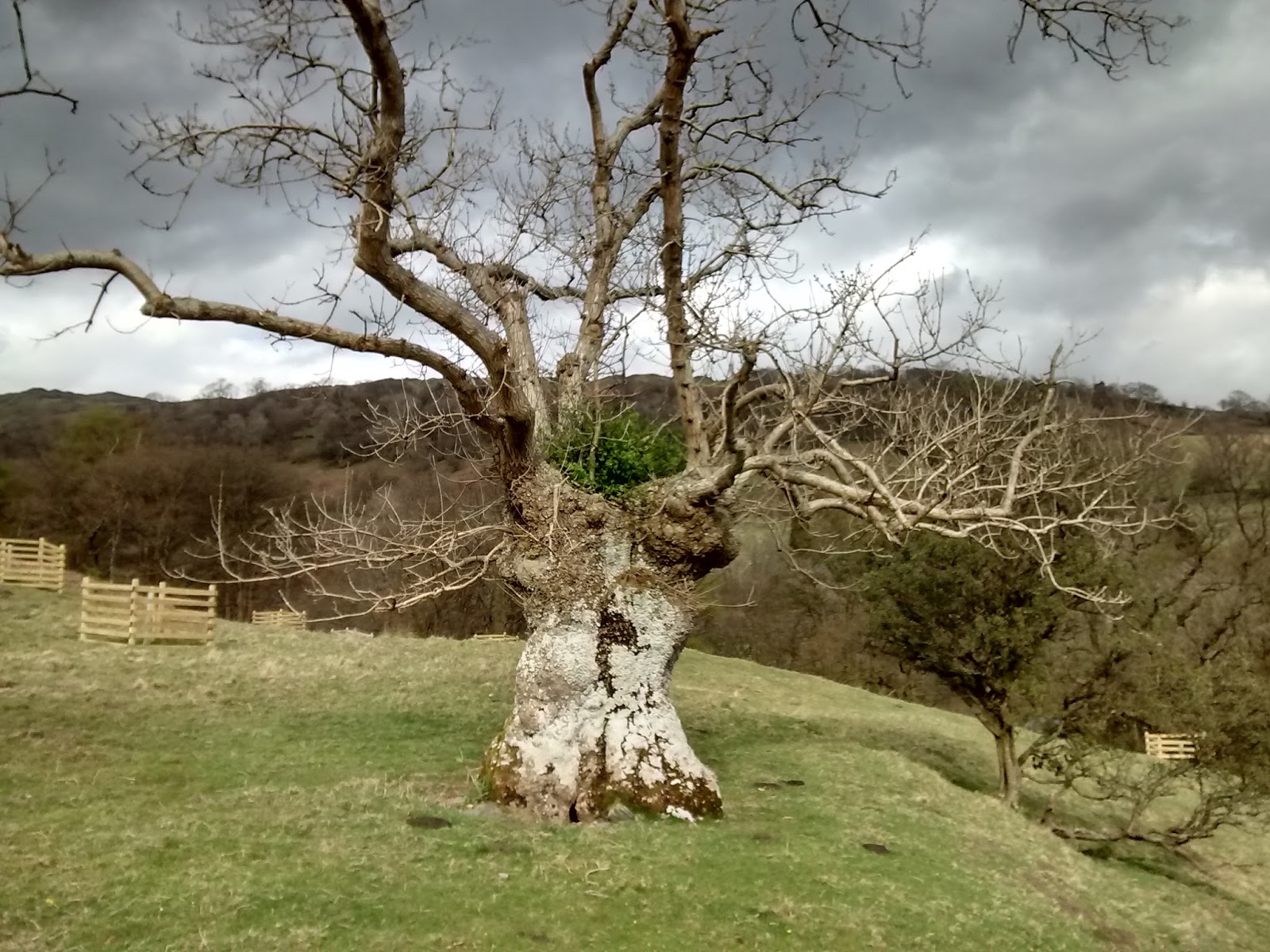
Sentinel ash pollard

North of Ambleside, Cumbria, near Scandale Beck.


How old is this beauty? Who first, and last, pollarded it? Where there other similar trees nearby, now lost? Imagine what it could tell you, the changes it has seen, if only it could talk.


I would like to show this tree to every person who continues to believe in free and globalised trade being more important than the risks from imported pests and diseases. People who thought a relatively small saving in growing their ash seedlings abroad could be made, when now the whole species is at risk. I wonder if (optimistically avoiding saying when) ash die-back will reach this tree?

Thursday, 14 April 2016

"Freedom from fear has arrived...

... but glory has departed" - Aldo Leopold.

The book 'Feral' by George Monbiot seemed to crystallise a feeling that I had been aware of but never really formalised before. Not only does he discuss ecological re-wilding, but also re-wilding our experiences of nature; how to alleviate "ecological boredom", as he coins it.

It's a good way of summing up that feel of something lacking as you walk through the woods or on the hills. You might see some run-of-the-mill birds; possibly a deer, white tail brightly contrasting with the greens and browns as it bounds away from you; maybe you'll flush up a hare, or a woodcock. You might see a dipper down by the stream. Maybe things will get more exciting every now and again - a bird of prey perhaps, or an adder slithering away into the undergrowth. If you're really lucky, and I mean really lucky, there are still some magical creatures around - otters in the rivers, or in a few places, pine martens might run through the trees.

But those encounters are few and far between. I've never come across a stream and found trees felled into dams by what looks like an axe, but you know it's not. Luckily, there are now (and only for now - let's not dare to dream) a few places in the UK where this might happen. But there's certainly no fear any more. I was surveying woodlands recently, in the middle of the forest, and yes - seeing deer and hare was interesting. A buzzard called overhead. But there was not even a tingle of excitement that I could share the landscape with something bigger and more dangerous.

I would love to see beavers in the streams. But more importantly, no matter the very small risk it would pose, I would love to at least feel a primeval fear knowing that there are large predators. Lynx in the forest? Wolves in larger areas, possibly areas of Scotland or perhaps northern England? I cannot even imagine the presence of bears in the woods, and I don't ever think I shall know it in the UK - although it must be an enjoyably terrifying thought in places where this is still a possibility.

Yes, some of these animals could pose a threat to humans. They could possibly threaten livestock, and pets. But is that a bad thing? We decide that we have the right to exist without them, but on what grounds? Our ego-centric perception of the natural world as one which we must control, dominate and sanitise has led to ecological loss beyond description, as seen in Yellowstone National Park (where apex predators are restoring vital ecosystem functioning). But it has also led to a loss of excitement and fear - a healthy, primal fear - that makes the countryside much more mundane and much too predictable compared to the real natural environment we should be part of.

We'll accept ridiculous risks from traffic, from chemicals, from unhealthy lifestyles, and yet even mention apex predators and half the nation goes up in arms (with significant lobbying power from self-interested farmers and gamekeepers, I feel). The dangers are over-stated, but the imperialist approaches to land management continue, depriving us all of a vital need to understand and develop a healthy respect for nature.

Re-wild our environment, yes - and whilst we're at it, re-wild our lives. 

Monday, 28 December 2015

Thoughts and floods

Whilst those directly affected by flooding must have more pressing concerns on their mind, and my heart goes out to them, I wonder if those in charge of town planning and environmental affairs should ponder the cause - and potential solutions - seriously.

Let's put aside for a second the wider (almost certain) cause of extreme weather events - climatic change, thanks to us. Let's keep the scope to flooding.


We fell the woodlands and clear the vegetation lining the watercourses, both near the source and further downstream. Trees will have a huge effect - water take up, hence reducing ground saturation; rooting that improves water percolating to the soils; and simply by being physical barriers slowing water, through their position but also dropping debris into rivers.


We all want bigger, detached houses, with that all important hard-standing for our cars. Meanwhile I see a worrying increase in paved, sterile gardens, sometimes even using artificial turf (because keeping lawns, or better still meadows, is such hard work when there's facebook to check). All of this further covers the amount of ground available to soak up water, let it enter the ground and not run off.


We think we no longer have the space to allow rivers to meander, find their own course and maybe dam up slightly every so often. We 'need' that land for farming. We, you and I, want to consume food as cheap as possible, pushing that intensive agriculture relying on artificial inputs, clearing hedges and riparian vegetation, and absolutely not having space for little bits of seasonal flooding. So we channel the rivers, quickening the flow and giving much less opportunity for percolation.


So water speeds up, doesn't have a chance to dissipate, reaches our concrete impermeable towns, and the inevitable happens. And politicians wring their hands from London, pretend that the answer is more walls, more sandbags, more barriers. More built solutions to a problem with a simple natural solution, money spent in the wrong places.


Why aren't we happy with smaller houses, greener urban landscapes, vegetation lined rivers? Who needs detached houses in a matrix of concrete and paving? Why won't we pay that bit more for food and allow farmers to leave riparian vegetation where it is. Let the rivers find their own courses, don't fight it. Reforest along the rivers, especially before they reach towns.


Where are our priorities?! We want new phones, boxing day sales, social media presence and status, and go to all manner of lengths to achieve them. But ask the people mopping out their homes and shops in the north if any of that matters to them right now. Or if we showed that riverside woods helped, would people accept less paving, less house space, and more natural space?


Yet another ecosystem service we've lost through greed and a sense of mastery. How many others will there be?

Thursday, 21 May 2015

A wild place

Another jaunt into Heath Bank Woods tonight, just as an antidote to three days straight in the office. I was studying recently about spiritual attachments to trees and forests, and how forests - even if not pristine - still represent nature, wilderness, and simplicity in contrast to our frantic and artificial modern lifestyles.

A few oak trees were too tempting not to climb, the first proper tree climbing this year. I climb trees way more now than I ever did when I was younger. There were no ropes, so climbing was both more liberated and more constrained at the same time. Sitting up in the top of the trees the wind could be felt more keenly, and it was easy to become half-lulled by the swaying.


Down near the stream is a notable old oak, hollowing out at the base. Last year I found this just a week or two too late - there were prolific chicken-of-the-woods fruiting in it, but just a bit too past it. In the winter they had turned white and rubbery, and for now only white patches of mycelia remained visible. There has, in the not-too-distant-past, been a fire in the base, and the inner wood is charred and blackened. You could stand in it, a bit of a squeeze and putting your head up into the dark, unopened upper part of the cavity, but you can still do it. The wood around the hollow is slowly buckling under the weight of the tree, but I reckon it still has plenty of years left. I drew my friend an old pirate-style map so he could find the tree and hopefully a bountiful fungus crop too.


Following a small track past the tree takes you down to the stream, and another oak only metres away has a lower bough comfortable enough to perch on. The wild garlic was in flower prolifically, and bluebells, ferns and other flora were carpeting the floor. The trickle of the stream was the only sound. I know that the wood is hardly 'untouched' - there are public footpaths, albeit rough ones, as well as occasional dog walkers and evidence of camping. Even the big hollowing oak has been touched - fire charring and graffiti on the decaying wood. But even so, it is nice to feel like you're in "the wilds". I suppose it's the so-called shifting baseline of what is considered 'natural' to each generation, as the world becomes more and more altered. 


It doesn't matter what analysis of historic land use and present influence you apply though. It's interesting to look for features of old influence, and to consider why some features are the way they are. But on the other hand my phone had run out of battery and I'd left my watch at home, so I sat there without any knowledge of how much time was spent there, just listening to the running water, feeling the moss on the tree, pondering and tuning out. It might not have been true wilderness, but it still felt natural.

Thursday, 30 October 2014

Talking the talk

Recently at work, I did a Picus on a veteran Ash tree on behalf of someone else's project. This was in the same week that I was talking to my boss (a high-up figure in the Arb Consultancy industry), who was proclaiming enthusiastically that he'd been talking to some other equally high-up consultant about the necessity to preserve veteran trees at the recent Arb Association conference. The Picus revealed about 50% hollowing from a major limb loss, so I recommended gradual reduction works, phased over a period of years.

The project was a development one, so I called the client just to explain what I had found. I was told this was a big problem, because the tree 'needed' to go to build a road into a new housing development. It appears that this road apparently over-ruled a 200 year old living organism. Anyway, I passed the buck, saying that I just did the Picus, those were my recommendations, but its not my project.


I then saw - by chance - an e-mail from my boss to these developers, saying that whilst the Picus couldn't be used to immediately justify felling for safety purposes, it could be used to indicate 'limited long-term usefulness' and so could justify removal for development. As a reminder, this is the same boss who stood there at an industry conference extolling the virtues of veteran trees. This is the same person who puts up, on linkedin and twitter and the like, endless posts about the importance of trees and the need to preserve them.


Now I hear that the council - rightly - put TPOs on the trees, and my company are supporting an objection to the TPOs.


This illustrates a massive flaw in the arb industry. Everyone talks the talk, claims to be an environmentalist, turns up at industry conferences and give speeches about how we must do more to protect our trees, integrate them into urban environments, "green the cities". But, when it comes to clients telling us what to do in light of their development (in itself, making a mockery of the British Standard for development in relation to trees), all that green-talk goes out of the window. No-one has a backbone to stand by their proclamations. I don't know if that's because people don't really believe it, or if (as I suspect) people are too scared of losing business to someone who will compromise.


If it's the latter case, then what the industry needs, as a whole, is to tighten up its ethical code. If you don't bend to a client's will, of course they're going to go to someone who will - and, since everyone is playing the game, there is always someone. However, if arboricultural consultants care about trees half as much as they publicise that they do, then if the industry united, tightened up, and advised, honestly and independently, instead of doing what clients tell them to do - then developers aren't going to go anywhere else, because every consultant will say it as it is, not what clients want. Then, the industry will truly be doing what it pretends at the moment to be doing - properly advising and caring for trees. 


Perhaps this needs the help of tree officers; at the end of the day, tree officers are all too often suspicious of consultants' motives (not without reason), whereas really we should all work together for the sake of what we (claim to?) believe in. Consultants advise, out of belief and passion for tree preservation; tree officers support it, through enforcement; and developers can't get what they want, when they want. Any consultants who do bend to the whim of their clients are quickly caught out by local authorities.


Sadly though, it will take some brave (and honest) people to stand up for what they believe in, in the face of losing business. However, if the industry is going to pat itself on the back and talk the environmental talk, then everyone should really start walking the walk - together.

Tuesday, 22 July 2014

A civilised society

Civilisation.

Where forests - carbon sinks, oxygen sources, habitat, water regulation, firewood, medicinal plants, huge biodiversity - are felled in huge swarths to provide bare land for building, or growing crops or animal feed.

Where we've "moved on" from eating edible plants to selecting vast monocultures of crops to grow. Where the soils have been depleted and natural resistance eroded, so we apply sticking plasters of toxic fertilisers and pesticides to prop it up for one extra season at a time. Where the natural balance of variation, and its benefits not only for biodiversity but also for food production, are ignored.

Where, to grow our crops, we remove trees that would provide alternative food sources, shade, natural soil binding and nutrients, and firewood for fuel. Where our soil, now empty and near-lifeless, washes into rivers.

Where we want driveways for our cars, or paved areas so we don't have to cut the grass, and so we pave over the soil. We cover the ground, and then bemoan the flooding that ensues. The flooding that is already worsened by the removal of riparian woodlands, and of wetlands that should be slowing the water rushing down the rivers.

Where conservation of the natural world, and all that it gives, has to fit in with the economy. Where we should be grateful for people "compromising", and leaving a bit of greenery whilst the rest is destroyed in pursuit of profit.

Where the belief is that everyone makes money and everyone's happy. Everyone can buy bigger houses, more material goods, flasher cars, and no-one loses. Well, only those people in sweatshops making the material goods. Only the environment, resources plundered to produce raw materials for goods. But that's irrelevant, as long as the money keeps flooding in.

Where its more important to 'fix the economy' and push the green agenda down in importance - it's all good to make vague promises about carbon reductions, but that's second place to making more money. All hail this artificial construct of the economy, of the stock market, of "the markets" that seem to rule all of human society. They're not even real, yet we worship them above all else.

Where we drive to work, drive home, shop at supermarkets, eat food of questionable origin, whilst we forget about who lives around us. Where we know more about what goes on in social media than we do about our neighbours' lives. We forget that our meat was once an animal, often maltreated and suffering before being slaughtered just for us.

Where we turn a blind eye to everything collapsing around us, and carry on as normal - make money, consume, repeat. Where we ignore the warning bells of a world pushed to the limit by our selfish, greed-driven behaviour.

Where corporations - businesses, mere businesses - now have the power to sue entire countries if they won't allow resource exploitation on their land

Sometimes it's hard to feel positive about 'civilisation'. I feel like we've taken a wrong turning somewhere.

Monday, 7 July 2014

BCEP in the woods

An environmental charity that my friend works for have recently taken over management of an urban woodland in Bradford, and he asked me if I'd be willing to do a bit of volunteering to help with the practical side of the woodland management. I must admit to missing the sunny days out in the woods and so happily said yes. So far, I've spent a couple of days there this summer, carving a fallen sycamore into a play feature for children and thinning out some dense sycamore over the footpath, to make it less gloomy and foreboding.

Partway through, with "steps up"
made along one co-dominant stem

  
A probable factor in the tree falling?
Dryad Saddle fruiting on the stump

Criss-cross cuts to make it less slippery

The finished piece...


Also spent a while thinning an area dominated by birch, where the charity hope to create a forest schools area for local pupils.

Before...

...after

In a geeky way, I find something so
aesthetically pleasing about birch logs!

There's still work to be done, and more thinning, but it's a nice project to be involved in and a way to hopefully utilise a slightly neglected and overlooked woodland.

Wednesday, 2 July 2014

New discoveries

A handful of more unusual trees that I've seen over the past wee while, mostly from Sheffield Botanic Gardens.

Cyprus cedar (Cedrus brevifolia) - a bit like an Atlas cedar, but with super small needles:


A strawberry tree (Arbutus unedo) - after seeing this, I recognised another on the same street as my girlfriend's house:


 A purple-leaved variety of Katsura (Cercidophyllum japonicum), one of my favourite trees due to its lovely, caramel smell in autumn. I think the variety may be 'Red Fox'?


Styrax japonicum - a snowdrop tree:


Whilst it is a native tree, I don't think I've ever seen a wild service tree (Sorbus torminalis) outside of collections. The craggy, patchwork brown and grey bark is lovely.


And, from Paignton Zoo in Devon, a cork oak (Quercus suber):


Finally, mulberry trees (Morus nigra) must be like buses - been looking for ages, and then have seen three this year. Even ran around one of them.


Sunday, 15 June 2014

A walk in the woods

Walking along Slades Road, the first footpath sign seems to point into someone's garden; a neat metal fence, with cars parked beyond it. The footpath further along is blocked by curious cows, so it's back to the first and cutting through someone's drive, feeling guilty even despite the Public Footpath fingerpost.

Past the stables and recent balsam clearance, and now I'm into Heath House Woods. Well, above it. The recent rain has freshened everything up, and this path cuts along the upper edge, bordered by young oaks, Sorbus, hawthorn, and other edge species. A first swig of Bowmore here (unashamedly inspired by Robert Macfarlane's whisky-fuelled strolls), whilst looking out above the woodland canopy of oaks that carpet the valley. It looks almost as though you could walk across to Heath House on top of these crowns.


Walk a bit further, and I come to a gated junction. To the left, back to Colne Valley. The cheers and shouts of a crowd as someone far away in Brazil scores, or doesn't score, reinforces the decision to turn right and head further into the woods. A little way in and a trail heads off steeply downhill, too tempting to ignore. Here, the oaks are contorted, squat and buckled, but no less lovely than those larger, open-grown trees you might see in a hedgerow.

A magpie flies through the canopy. One for sorrow. The grasses and brambles are laden with cuckoo spit, I don't know if I've ever seen more in one spot. Finally, another magpie joins the first. Two for joy - a far more optimistic prospect. A roaring in the distance sounds like a waterfall, although it is just as likely to be a mill or even some machinery somewhere. However, the babbling of a beck at the bottom of the slope is unmistakable, and so I head down. On the way, wonder about the wood's history. Planted, or a remnant of what used to be? Worked, and by whom, and why? And does that even matter, or should we just enjoy wondering in woods, rather than analyse them? 


A tyre swing and further tyres making up stepping stones by no means detract from the strength of the oak on the opposite bank, which must have stood sentinel by the beck for a century at least. However, as well intentioned as the tyres may be, they still remind of the uncomfortable proximity of the town to the left. So across the burn a turn right, heading up past a decaying log. The tree must have fallen naturally, but the clean cuts and branch stubs show that at least once someone has been in here with a saw.

Following the beck upstream, it forks into two. Each of the gulleys along which it heads are lush and green; it might not be as vast, stirring, symbolic or emotive as the Amazon, but these oak woodlands are our temperate rainforests. And the lichens on branches, the fungi and ground fauna, the birds calling still demonstrate the diversity of these woods. A jay flits across the beck and alights on a branch, silhouetted and quieter than its rowdier, black and white cousins. 


I cross back over the beck and head upwards, slipping on the wet mud, finally reaching a defined path cutting across perpendicular. A squat oak here offers two nice boughs for a seat and so I sit for a while, taking a few swigs and enjoying the sound of water, whilst admiring the fresh pink on newly flushed epicormic growths.


Further on, I come to a bridge crossed on a previous stroll, and realise that this path leads out, eventually, to the cows. So an about turn, and taking a left fork that eventually leads out to a more widely spaced area. I've been here before, taking a seat in an oak in the sun and whimsically fantasising about building a hut here, leaving civilisation as we know it to live in the woods. I had begun to plan it out - planting edible plants, thinking of water sources - a beautiful distraction from our everyday lives.


Back up to that gated junction, following the track out to find a large house and grounds. Someone with the money to buy a lovely patch of land, but without the sense to take only what they need from it. It's hard to ignore the urge to head back now, back into the woods. and so that's what I do; picking up that original path out. Halfway along, a small track leads down, again too intriguing not to followed. It ends up leading out to an oak begging to be climbed; dropping towards it, and it become apparent this is the top of my imagined woodland settlement. Oh, well. Climb the tree, a couple more swigs, listen to chaffinches piping alarm. Savour the greenery, the stillness, the simplicity. Then back out to the path, to someone's garden, and finally to tarmac once more.