
About Me
- Treecological
- Cumbria, United Kingdom
- A forester, naturalist and environmentalist.
Friday, 24 August 2012

Saturday, 11 August 2012
Pholiota squarrosa
...found on a walnut species (Juglans ailanthifolia).


After looking up Pholiota squarrosa in Weber & Mattheck's highly-recommended Manual of Wood Decays in Trees, it appears this fungus is a simultaneous white rotter. I've been trying to get my head around rot types for a while now, and as far as I understand simultaneous white rot attacks both the lignin in the wood (which gives the wood stiffness, especially radially) and the cellulose and hemicelluloses (which give the wood bending strength, as well as strength under compression from the weight above). So, the degradation of cellulose first makes the wood brittle, and then degradation of lignin softens the wood and removes strength.
So as (if?) the decay progresses in this walnut, it could suffer a brittle fracture in strong winds (with the loss of cellulose), then become at risk of ductile fracture as the lignin is decayed. Plus, there were clumps of fruiting bodies on both the north-west and the south-east to the trunk, which I think can be interpreted as showing decay could be fairly advanced and is not limited to just one side of the tree.
Does anyone who might be reading this know if I'm interpreting this along the right tracks?


After looking up Pholiota squarrosa in Weber & Mattheck's highly-recommended Manual of Wood Decays in Trees, it appears this fungus is a simultaneous white rotter. I've been trying to get my head around rot types for a while now, and as far as I understand simultaneous white rot attacks both the lignin in the wood (which gives the wood stiffness, especially radially) and the cellulose and hemicelluloses (which give the wood bending strength, as well as strength under compression from the weight above). So, the degradation of cellulose first makes the wood brittle, and then degradation of lignin softens the wood and removes strength.
So as (if?) the decay progresses in this walnut, it could suffer a brittle fracture in strong winds (with the loss of cellulose), then become at risk of ductile fracture as the lignin is decayed. Plus, there were clumps of fruiting bodies on both the north-west and the south-east to the trunk, which I think can be interpreted as showing decay could be fairly advanced and is not limited to just one side of the tree.
Does anyone who might be reading this know if I'm interpreting this along the right tracks?
Sunday, 29 July 2012
The woods around Loch Leven
Earlier in the year a friend and I went for a wander around Loch Leven, near Kinross. I was looking back over the photos today and it reminded me of how refreshing some of the woodland was. Walking from the RSPB reserve (Vane Farm) anti-clockwise around the loch, we passed veteran oak trees into a more closely-packed birch-dominated woodland with wet areas of willow and alder, and some Scots pine (presumably an old plantation?) thrown in.
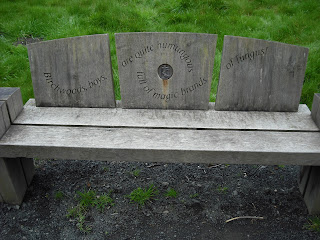
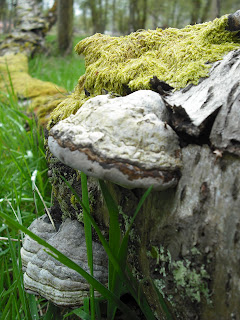
There was a lovely sense of untidyness prevailing here - log piles, standing and fallen deadwood everywhere, and natural-feeling paths. The veteran oaks were stag-headed, had hollow cavities and were generally scruffy looking - and all the better for it. Tinder fungus (Fomes fomentarius) and birch polypore (Piptoporus betulinus) were everywhere, with birch trees in various stages of collapse because of them, and all the trees and logs were covered in a variety of mosses and lichens.

The only curiosity was a distinct lack of young trees and an understorey. Could this be from deer or sheep grazing? Certainly the fences could have done with some TLC. Or could it be that this woodland is in fact a neglected plantation, thus accounting for some of the lack of the variety of tree ages? Perhaps the pine plantation spread further throughout the woods, and the birch is a secondary woodland arising from the felling of part of it? It would be interesting to go back now the growing season is well under way and try to make sense of what the flower communities are telling us about the woodland's history.


There was a lovely sense of untidyness prevailing here - log piles, standing and fallen deadwood everywhere, and natural-feeling paths. The veteran oaks were stag-headed, had hollow cavities and were generally scruffy looking - and all the better for it. Tinder fungus (Fomes fomentarius) and birch polypore (Piptoporus betulinus) were everywhere, with birch trees in various stages of collapse because of them, and all the trees and logs were covered in a variety of mosses and lichens.


The only curiosity was a distinct lack of young trees and an understorey. Could this be from deer or sheep grazing? Certainly the fences could have done with some TLC. Or could it be that this woodland is in fact a neglected plantation, thus accounting for some of the lack of the variety of tree ages? Perhaps the pine plantation spread further throughout the woods, and the birch is a secondary woodland arising from the felling of part of it? It would be interesting to go back now the growing season is well under way and try to make sense of what the flower communities are telling us about the woodland's history.

Sunday, 22 July 2012
Phototropism
Trees are living natural sculptures... who wants nice neat leaders with single straight stems when you can have trees like these?
 |
| A birch at the RSPB reserve at Loch Leven |
 |
| An oak amidst spruce at Dean Country Park, Kilmarnock |
 |
| A lime at Newhailes estate near Edinburgh |
Friday, 20 July 2012
Spalted birch
By pure chance I sawed up an old rotting ring of birch trunk to put it through the chipper at work. Inside on the freshly-cut surfaces was a beautiful spalting pattern - I've seen it on beech before, and even have a lovely spalted-beech bowl turned by my partner's papa, but never seen it on birch before. There was honey fungus bootlaces all over it, but perhaps other fungi have been attacking it too? Either way, the battle between fungus (fungi?) and tree have been beautifully documented, with the tree laying down its defence system by biochemically altering the wood, and the fungus eventually overcoming it and forcing the tree to draw new battleground lines. OK, a slightly anthropological view, but that's roughly what has happened.


Tuesday, 19 June 2012
Veteran sweet chestnuts
The Ancient Tree Hunt is a collaboration between the Woodland Trust and the Ancient Tree Forum which aims to map all the 'ancient, notable and veteran' trees in the UK... a big undertaking but an interesting one, not least because people are getting out and thinking about all the big, old, lovely and/or important and culturally significant trees they know.

+(5).JPG)
+(1).JPG)
+(2).JPG)

http://www.ancient-tree-hunt.org.uk/
I've recorded trees before, whilst working as a seasonal ranger. And after spending a rainy Sunday at the Royal Botanic Gardens Edinburgh, collecting data for tree surveys for college work, I added two of the biggest sweet chestnuts there to the database.
One is by the pond, with nesting birds in holes and a great stag-headed quality to most of the larger branches.

+(5).JPG)
The other, perhaps more noticeable, is the big old tree standing on the corner of the rock garden - right alongside a well-travelled path from the East Gate down to the south. This one lost one of three large limbs during recent storms, and has a huge wound that looks great - it tells a story and gives an indication of the tree's life history. I hope that at least some people stop and think twice about this tree - about how it is a living being far older than any person in the world, about what it has 'seen' in its life and about what it means to preserve trees like these.
+(1).JPG)
+(2).JPG)

Sunday, 17 June 2012
Coronet cuts
I did my first coronet cuts (more 'natural-looking' cuts that simulate a tear or snap on a branch) on a southern beech (Nothofagus) at work this week. It was hidden away in a small copse-like part of the garden, so my boss asked me to reduce about four 'large' dead limbs (to reduce the weight and prevent them falling on a fence below) but leave a couple of feet for habitat.
I've never been shown how to do it, but I've seen photos and heard descriptions, so thought I'd give it a go at ending the 'stubs' with coronet cuts. Here's some of the results:


They're probably not as good as guys who've been doing them a while, and I know they're only a small branches, but for me a step in the right direction - this kind of work is part of what I'd like to do. And it was good to be doing them in a Botanic Garden, somewhere where I never thought they'd want "untidy" looking coronet-cuts... luckily this tree was hidden away enough to get away with it.
I've never been shown how to do it, but I've seen photos and heard descriptions, so thought I'd give it a go at ending the 'stubs' with coronet cuts. Here's some of the results:


They're probably not as good as guys who've been doing them a while, and I know they're only a small branches, but for me a step in the right direction - this kind of work is part of what I'd like to do. And it was good to be doing them in a Botanic Garden, somewhere where I never thought they'd want "untidy" looking coronet-cuts... luckily this tree was hidden away enough to get away with it.
Subscribe to:
Posts (Atom)