
About Me
- Treecological
- Cumbria, United Kingdom
- A forester, naturalist and environmentalist.
Sunday, 28 July 2013
Contour lines
Close-up of the bark on a mature sycamore... nature creates sculptures, textures and colours that artists can only dream of.


Sunday, 3 March 2013
Fencing in the woods
In a small community woodland in a deprived area of Glasgow, we put up this fence the other day.
All the hazel used for it was coppiced within 10m of the worksite; it gave the woodland edge (unfortunately a single-aged broadleaf plantation with trees in racks) a bit more age variety.
Cost of materials = £0
Cost of labour = two employees, one day
Hopefully it not only marks out a dip in the ground, but makes the woods a wee bit more interesting to visit.


All the hazel used for it was coppiced within 10m of the worksite; it gave the woodland edge (unfortunately a single-aged broadleaf plantation with trees in racks) a bit more age variety.
Cost of materials = £0
Cost of labour = two employees, one day
Hopefully it not only marks out a dip in the ground, but makes the woods a wee bit more interesting to visit.


Dignity with age
When do ancient and veteran trees lose their dignity for the sake of preservation?
I am all for keeping trees going as long as possible. In fact (warning: hippy-sounding-statement) I think its a bit of a con to believe that a human life is inherently worth more than the life of a tree, and so the idea of removing trees that have lived, grown and seen 150, 200, maybe more years, just for our safety and convenience... its not entirely right in my opinion. We should look at ways of adjusting human behaviour to retain important trees, as well as sensitively working on the trees to reduce their hazard potential. That's why I posted about the sweet chestnut at Temple Newsam park in Leeds - the tree was vigorous, stable and posed no danger, thanks to both remedial tree surgery and the removal of targets/fencing off the tree.
However... when do we do so much work to trees that they are butchered, unrecognisable, and undignified, all for the sake of retention?
Last weekend a friend and I drove through the small town of Balfron, near Loch Lomond, specifically to have a good look at the Clachan Oak. However, I was slightly disappointed.
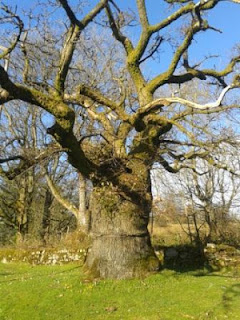


Don't get me wrong, the tree itself was impressive. It had been reduced, partly through tree surgery but also partly retrenchment. This gave it a lovely stag-headed quality. The tree was hollow inside, and apparently in the past a certain William Wallace has rested beneath it. I have no issues at all with people trying to save it; in fact, I would chain myself to it if I heard of people coming to fell it!
However, my issue is with how it has been retained. OK, I can understand and sympathise with the three big metal bands to hold the trunk together; it is, after all, next to the road through the village. But planks of wood to block up the internal cavity? Rust nails sticking out of them? One lying on the floor where it has fallen? Perhaps this is to stop someone climbing into the tree's cavity, and getting stuck or crushed. But really. If someone is going to do that, let them. Or, put up a small sign, perhaps giving some of the history of the tree and a small warning not to climb on it.
I loved the vibe and the feel of this tree, and would like to see it standing until it decides to fail, not until we decide to remove it. But lets give it the dignity that a being of this incomprehensible age should deserve; this tree will have 'seen' the village expand, travellers on horse back through the lane becoming motorists, and perhaps famous Scots resting underneath it. So lets put up a tasteful fence around it, perhaps make it more of a 'feature' to inform others about why it is so important, and remove those awful looking planks from its trunk.
I am all for keeping trees going as long as possible. In fact (warning: hippy-sounding-statement) I think its a bit of a con to believe that a human life is inherently worth more than the life of a tree, and so the idea of removing trees that have lived, grown and seen 150, 200, maybe more years, just for our safety and convenience... its not entirely right in my opinion. We should look at ways of adjusting human behaviour to retain important trees, as well as sensitively working on the trees to reduce their hazard potential. That's why I posted about the sweet chestnut at Temple Newsam park in Leeds - the tree was vigorous, stable and posed no danger, thanks to both remedial tree surgery and the removal of targets/fencing off the tree.
However... when do we do so much work to trees that they are butchered, unrecognisable, and undignified, all for the sake of retention?
Last weekend a friend and I drove through the small town of Balfron, near Loch Lomond, specifically to have a good look at the Clachan Oak. However, I was slightly disappointed.


Don't get me wrong, the tree itself was impressive. It had been reduced, partly through tree surgery but also partly retrenchment. This gave it a lovely stag-headed quality. The tree was hollow inside, and apparently in the past a certain William Wallace has rested beneath it. I have no issues at all with people trying to save it; in fact, I would chain myself to it if I heard of people coming to fell it!
However, my issue is with how it has been retained. OK, I can understand and sympathise with the three big metal bands to hold the trunk together; it is, after all, next to the road through the village. But planks of wood to block up the internal cavity? Rust nails sticking out of them? One lying on the floor where it has fallen? Perhaps this is to stop someone climbing into the tree's cavity, and getting stuck or crushed. But really. If someone is going to do that, let them. Or, put up a small sign, perhaps giving some of the history of the tree and a small warning not to climb on it.
I loved the vibe and the feel of this tree, and would like to see it standing until it decides to fail, not until we decide to remove it. But lets give it the dignity that a being of this incomprehensible age should deserve; this tree will have 'seen' the village expand, travellers on horse back through the lane becoming motorists, and perhaps famous Scots resting underneath it. So lets put up a tasteful fence around it, perhaps make it more of a 'feature' to inform others about why it is so important, and remove those awful looking planks from its trunk.
Friday, 24 August 2012

Saturday, 11 August 2012
Pholiota squarrosa
...found on a walnut species (Juglans ailanthifolia).


After looking up Pholiota squarrosa in Weber & Mattheck's highly-recommended Manual of Wood Decays in Trees, it appears this fungus is a simultaneous white rotter. I've been trying to get my head around rot types for a while now, and as far as I understand simultaneous white rot attacks both the lignin in the wood (which gives the wood stiffness, especially radially) and the cellulose and hemicelluloses (which give the wood bending strength, as well as strength under compression from the weight above). So, the degradation of cellulose first makes the wood brittle, and then degradation of lignin softens the wood and removes strength.
So as (if?) the decay progresses in this walnut, it could suffer a brittle fracture in strong winds (with the loss of cellulose), then become at risk of ductile fracture as the lignin is decayed. Plus, there were clumps of fruiting bodies on both the north-west and the south-east to the trunk, which I think can be interpreted as showing decay could be fairly advanced and is not limited to just one side of the tree.
Does anyone who might be reading this know if I'm interpreting this along the right tracks?


After looking up Pholiota squarrosa in Weber & Mattheck's highly-recommended Manual of Wood Decays in Trees, it appears this fungus is a simultaneous white rotter. I've been trying to get my head around rot types for a while now, and as far as I understand simultaneous white rot attacks both the lignin in the wood (which gives the wood stiffness, especially radially) and the cellulose and hemicelluloses (which give the wood bending strength, as well as strength under compression from the weight above). So, the degradation of cellulose first makes the wood brittle, and then degradation of lignin softens the wood and removes strength.
So as (if?) the decay progresses in this walnut, it could suffer a brittle fracture in strong winds (with the loss of cellulose), then become at risk of ductile fracture as the lignin is decayed. Plus, there were clumps of fruiting bodies on both the north-west and the south-east to the trunk, which I think can be interpreted as showing decay could be fairly advanced and is not limited to just one side of the tree.
Does anyone who might be reading this know if I'm interpreting this along the right tracks?
Sunday, 29 July 2012
The woods around Loch Leven
Earlier in the year a friend and I went for a wander around Loch Leven, near Kinross. I was looking back over the photos today and it reminded me of how refreshing some of the woodland was. Walking from the RSPB reserve (Vane Farm) anti-clockwise around the loch, we passed veteran oak trees into a more closely-packed birch-dominated woodland with wet areas of willow and alder, and some Scots pine (presumably an old plantation?) thrown in.
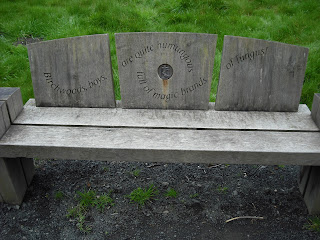
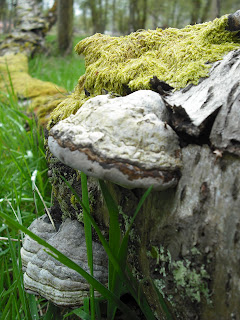
There was a lovely sense of untidyness prevailing here - log piles, standing and fallen deadwood everywhere, and natural-feeling paths. The veteran oaks were stag-headed, had hollow cavities and were generally scruffy looking - and all the better for it. Tinder fungus (Fomes fomentarius) and birch polypore (Piptoporus betulinus) were everywhere, with birch trees in various stages of collapse because of them, and all the trees and logs were covered in a variety of mosses and lichens.

The only curiosity was a distinct lack of young trees and an understorey. Could this be from deer or sheep grazing? Certainly the fences could have done with some TLC. Or could it be that this woodland is in fact a neglected plantation, thus accounting for some of the lack of the variety of tree ages? Perhaps the pine plantation spread further throughout the woods, and the birch is a secondary woodland arising from the felling of part of it? It would be interesting to go back now the growing season is well under way and try to make sense of what the flower communities are telling us about the woodland's history.


There was a lovely sense of untidyness prevailing here - log piles, standing and fallen deadwood everywhere, and natural-feeling paths. The veteran oaks were stag-headed, had hollow cavities and were generally scruffy looking - and all the better for it. Tinder fungus (Fomes fomentarius) and birch polypore (Piptoporus betulinus) were everywhere, with birch trees in various stages of collapse because of them, and all the trees and logs were covered in a variety of mosses and lichens.


The only curiosity was a distinct lack of young trees and an understorey. Could this be from deer or sheep grazing? Certainly the fences could have done with some TLC. Or could it be that this woodland is in fact a neglected plantation, thus accounting for some of the lack of the variety of tree ages? Perhaps the pine plantation spread further throughout the woods, and the birch is a secondary woodland arising from the felling of part of it? It would be interesting to go back now the growing season is well under way and try to make sense of what the flower communities are telling us about the woodland's history.

Sunday, 22 July 2012
Phototropism
Trees are living natural sculptures... who wants nice neat leaders with single straight stems when you can have trees like these?
 |
| A birch at the RSPB reserve at Loch Leven |
 |
| An oak amidst spruce at Dean Country Park, Kilmarnock |
 |
| A lime at Newhailes estate near Edinburgh |
Subscribe to:
Posts (Atom)