On Sunday, UNESCO will make a decision about whether or not to make the Lake District a World Heritage Site (WHS). Not for the first time - two attempts to recognise it as a site with outstanding natural heritage failed because, well, ecologically it's pretty poor. So this bid is based instead of cultural heritage, pinned firmly and foremost on hill farming, the area's overwhelming land use.
Read the National Park Partnership's management plan and you'd be drawn into believing that our rosy-cheeked 'guardians of the countryside' live in harmony with nature, tending to their flocks amongst the wild flowers and with the utmost of sensitivity. They're responsible for looking after this beautiful landscape, with its 'naturally' open hills and smattering of copses of mature trees.
Hmmm. Dig a bit deeper. The agro-pastoral tradition celebrated by the plan and the bid is, in reality, ranching sheep in every last corner of the Lakes that isn't a town. Rosy-cheeked farmers are propped up by our tax money, because they make a loss on every sheep they own. But that's OK, because it's cultural heritage, right? Well, no doubt that hill farming has a long history in the Lakes - but so too does mining, quarrying, coppicing and even planting larch blocks. And they're not celebrated, and certainly not continued at public expense; perhaps they don't have as good links to the Conservative government as agricultural and land-owning lobbyists.
Well, OK, but we need sheep for nature conservation right? Maintaining vital semi-natural habitats? Wrong - that same old argument gets trotted out time after time, not only by National Park Authorities but also by those utterly unbiased landowner organisations like the Countryside Alliance. But it's a fallacy - biodiversity in the Lakes has fallen, water quality deteriorated, soils destroyed, habitats degraded. Why are there so many mature, lovely trees, but no young ones growing to replace them? Anything to do with sheep, perhaps?
Dig deeper into that management plan, find the stats buried under picture after picture of Herdwick sheep, and they paint a different picture. That 'natural' beauty? Completely unnatural. Have a walk up Loughrigg in spring and see the woodland wild flowers clinging on in what is now grazed common - it tells you all you need to know about the natural ecosystem that should be there. The "wealth of wildlife" lacks any predator bigger than a fox (and even they get shot), let alone creatures like pine martens, hen harriers, polecats, and even now golden eagles.
So it's back to the cultural heritage argument; it's worth subsidising a loss-making industry causing huge ecological problems because of our rosy-cheeked guardians of the countryside. But I see little shepherding out there in the Lakes, few hay meadows or mixed farming systems; I see bright-green, over-fertilised fields, farmers doing the bare minimum they can whilst claiming subsidy for every last square-metre, sheep chucked out on hills all year round.
The fact that this bid exists is laughable; the fact it may become reality is frightening, legitimising continued, unprofitable, damaging sheep everywhere, as far as the eye can see. Paranoia? As the Federation of Cumbria Commoners said, WHS status would give hill farming "a powerful weapon" to fight for its continuation, whilst the Lakes floods again and again, woodlands become moribund and disappear, and wildlife in what is still technically an IUCN protected area remains a shadow of what it could be. Protected areas that should protect natural ecosystems, not areas where the land is completely managed by a non-native and arguably invasive woolly species and where little if any land is left to follow natural dynamics.
Ironically, the third "outstanding universal value" of the Lakes is the conservation movement that started with Wordsworth and Ruskin, fighting to protect what they perceived as a natural and wild landscape from industrial threats. Let's celebrate that conservation movement now... Oh, hang on, it's villified for buying land to farm more sensitively, for trying to re-naturalise rivers, for trying some form of land management other than sheep farming. What about industrial threats to the Lake District today? Well, come Monday we may be internationally celebrating the biggest one there is - sheep farming.
About Me
- Treecological
- Cumbria, United Kingdom
- A forester, naturalist and environmentalist.
Thursday, 6 July 2017

Saturday, 22 April 2017
An otter... against the odds
Tonight, at the usual spot, I finally saw the otters I'd been told about.
Sitting on a silty 'beach' by the river, enjoying the peace, the birdsong, the absence of people, the occasional splash of a fish on the water. I was aware of, but not particularly expectant from, some splashing in the water. Seeing a lonely swallow flying earlier had heightened a sense of... I don't know really. It was kind of melancholic in a way.
Turns out that, having told myself it wouldn't be, the splashing was actually an otter. Or a pair of them, which proceeded to tumble their way across the far bank of the river in front of me over the next ten minutes or so. Otters are something magical, slightly other worldly, elusive; it feels like a privilege to see them, as if they are letting their guard down and inviting you to watch their secret show. I was scared to move so stood, rooted to the spot, as they constantly dove in one beautiful motion, with the back arching as they ducked and the tail slipping in after. At one point one of the pair half-climbed the bank as if exploring the land, whiskers glinting in the evening sun.
For some reason I felt tears in my eyes and my pulse quickening. In some respects, this was euphoria at seeing such wonderful creatures in what was already a peaceful, strangely 'real' evening after a day at a desk. A roe deer or two grazing the rough grass behind the otters added to the effect. But after thinking a lot recently about a wilder national park, one where nature comes first or at least equal, it also felt saddening watching the otters. I imagined the otter hounds that not long ago chased these beautiful beings, and why? Because humans seem unable to co-exist with anything moderately large. I thought about the pesticides, chemicals and litter that were no doubt in the river they swam in, simply because of greed, ignorance and selfishness. They seemed to me lonely, beautiful and enchanting yes, but only parts of what once was, a fully functioning, natural, wild ecosystem now stripped down and malfunctioning because of us.
Another roe deer, a young buck, watched me warily walk past on the way home. It's undeniable that they're handsome, with trembling eyes and smart antlers, but the pessimist in me saw even further evidence of what we've lost in the three nonchalant, quite unperturbed deer sharing the fields, safe in the knowledge we've removed all their predators.
Sitting on a silty 'beach' by the river, enjoying the peace, the birdsong, the absence of people, the occasional splash of a fish on the water. I was aware of, but not particularly expectant from, some splashing in the water. Seeing a lonely swallow flying earlier had heightened a sense of... I don't know really. It was kind of melancholic in a way.
Turns out that, having told myself it wouldn't be, the splashing was actually an otter. Or a pair of them, which proceeded to tumble their way across the far bank of the river in front of me over the next ten minutes or so. Otters are something magical, slightly other worldly, elusive; it feels like a privilege to see them, as if they are letting their guard down and inviting you to watch their secret show. I was scared to move so stood, rooted to the spot, as they constantly dove in one beautiful motion, with the back arching as they ducked and the tail slipping in after. At one point one of the pair half-climbed the bank as if exploring the land, whiskers glinting in the evening sun.
For some reason I felt tears in my eyes and my pulse quickening. In some respects, this was euphoria at seeing such wonderful creatures in what was already a peaceful, strangely 'real' evening after a day at a desk. A roe deer or two grazing the rough grass behind the otters added to the effect. But after thinking a lot recently about a wilder national park, one where nature comes first or at least equal, it also felt saddening watching the otters. I imagined the otter hounds that not long ago chased these beautiful beings, and why? Because humans seem unable to co-exist with anything moderately large. I thought about the pesticides, chemicals and litter that were no doubt in the river they swam in, simply because of greed, ignorance and selfishness. They seemed to me lonely, beautiful and enchanting yes, but only parts of what once was, a fully functioning, natural, wild ecosystem now stripped down and malfunctioning because of us.
Another roe deer, a young buck, watched me warily walk past on the way home. It's undeniable that they're handsome, with trembling eyes and smart antlers, but the pessimist in me saw even further evidence of what we've lost in the three nonchalant, quite unperturbed deer sharing the fields, safe in the knowledge we've removed all their predators.
Sunday, 24 April 2016
Sentinel ash pollard
North of Ambleside, Cumbria, near Scandale Beck.

How old is this beauty? Who first, and last, pollarded it? Where there other similar trees nearby, now lost? Imagine what it could tell you, the changes it has seen, if only it could talk.

I would like to show this tree to every person who continues to believe in free and globalised trade being more important than the risks from imported pests and diseases. People who thought a relatively small saving in growing their ash seedlings abroad could be made, when now the whole species is at risk. I wonder if (optimistically avoiding saying when) ash die-back will reach this tree?

How old is this beauty? Who first, and last, pollarded it? Where there other similar trees nearby, now lost? Imagine what it could tell you, the changes it has seen, if only it could talk.
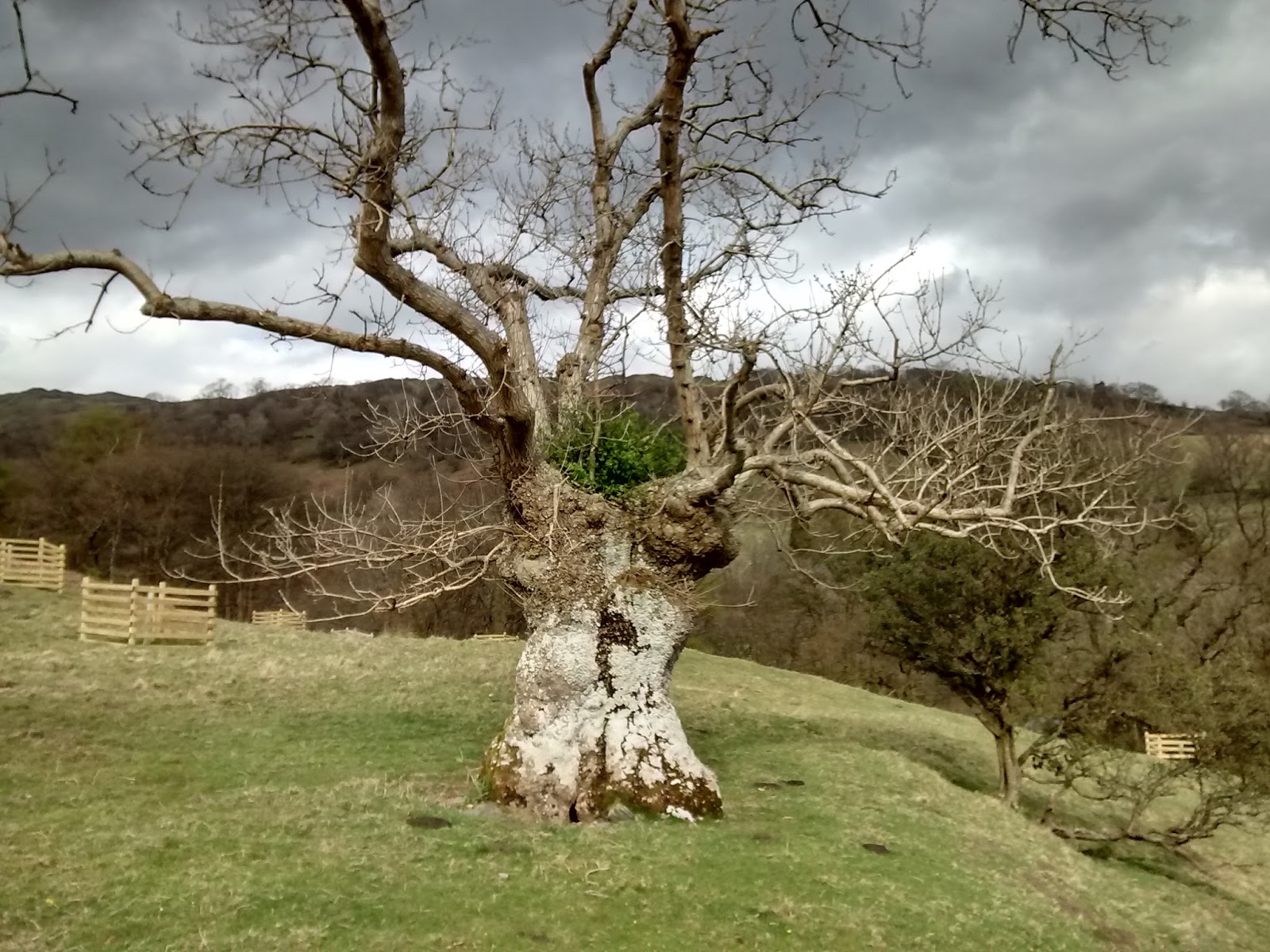
I would like to show this tree to every person who continues to believe in free and globalised trade being more important than the risks from imported pests and diseases. People who thought a relatively small saving in growing their ash seedlings abroad could be made, when now the whole species is at risk. I wonder if (optimistically avoiding saying when) ash die-back will reach this tree?
Thursday, 14 April 2016
"Freedom from fear has arrived...
... but glory has departed" - Aldo Leopold.
The book 'Feral' by George Monbiot seemed to crystallise a feeling that I had been aware of but never really formalised before. Not only does he discuss ecological re-wilding, but also re-wilding our experiences of nature; how to alleviate "ecological boredom", as he coins it.
It's a good way of summing up that feel of something lacking as you walk through the woods or on the hills. You might see some run-of-the-mill birds; possibly a deer, white tail brightly contrasting with the greens and browns as it bounds away from you; maybe you'll flush up a hare, or a woodcock. You might see a dipper down by the stream. Maybe things will get more exciting every now and again - a bird of prey perhaps, or an adder slithering away into the undergrowth. If you're really lucky, and I mean really lucky, there are still some magical creatures around - otters in the rivers, or in a few places, pine martens might run through the trees.
But those encounters are few and far between. I've never come across a stream and found trees felled into dams by what looks like an axe, but you know it's not. Luckily, there are now (and only for now - let's not dare to dream) a few places in the UK where this might happen. But there's certainly no fear any more. I was surveying woodlands recently, in the middle of the forest, and yes - seeing deer and hare was interesting. A buzzard called overhead. But there was not even a tingle of excitement that I could share the landscape with something bigger and more dangerous.
I would love to see beavers in the streams. But more importantly, no matter the very small risk it would pose, I would love to at least feel a primeval fear knowing that there are large predators. Lynx in the forest? Wolves in larger areas, possibly areas of Scotland or perhaps northern England? I cannot even imagine the presence of bears in the woods, and I don't ever think I shall know it in the UK - although it must be an enjoyably terrifying thought in places where this is still a possibility.
Yes, some of these animals could pose a threat to humans. They could possibly threaten livestock, and pets. But is that a bad thing? We decide that we have the right to exist without them, but on what grounds? Our ego-centric perception of the natural world as one which we must control, dominate and sanitise has led to ecological loss beyond description, as seen in Yellowstone National Park (where apex predators are restoring vital ecosystem functioning). But it has also led to a loss of excitement and fear - a healthy, primal fear - that makes the countryside much more mundane and much too predictable compared to the real natural environment we should be part of.
We'll accept ridiculous risks from traffic, from chemicals, from unhealthy lifestyles, and yet even mention apex predators and half the nation goes up in arms (with significant lobbying power from self-interested farmers and gamekeepers, I feel). The dangers are over-stated, but the imperialist approaches to land management continue, depriving us all of a vital need to understand and develop a healthy respect for nature.
Re-wild our environment, yes - and whilst we're at it, re-wild our lives.
The book 'Feral' by George Monbiot seemed to crystallise a feeling that I had been aware of but never really formalised before. Not only does he discuss ecological re-wilding, but also re-wilding our experiences of nature; how to alleviate "ecological boredom", as he coins it.
It's a good way of summing up that feel of something lacking as you walk through the woods or on the hills. You might see some run-of-the-mill birds; possibly a deer, white tail brightly contrasting with the greens and browns as it bounds away from you; maybe you'll flush up a hare, or a woodcock. You might see a dipper down by the stream. Maybe things will get more exciting every now and again - a bird of prey perhaps, or an adder slithering away into the undergrowth. If you're really lucky, and I mean really lucky, there are still some magical creatures around - otters in the rivers, or in a few places, pine martens might run through the trees.
But those encounters are few and far between. I've never come across a stream and found trees felled into dams by what looks like an axe, but you know it's not. Luckily, there are now (and only for now - let's not dare to dream) a few places in the UK where this might happen. But there's certainly no fear any more. I was surveying woodlands recently, in the middle of the forest, and yes - seeing deer and hare was interesting. A buzzard called overhead. But there was not even a tingle of excitement that I could share the landscape with something bigger and more dangerous.
I would love to see beavers in the streams. But more importantly, no matter the very small risk it would pose, I would love to at least feel a primeval fear knowing that there are large predators. Lynx in the forest? Wolves in larger areas, possibly areas of Scotland or perhaps northern England? I cannot even imagine the presence of bears in the woods, and I don't ever think I shall know it in the UK - although it must be an enjoyably terrifying thought in places where this is still a possibility.
Yes, some of these animals could pose a threat to humans. They could possibly threaten livestock, and pets. But is that a bad thing? We decide that we have the right to exist without them, but on what grounds? Our ego-centric perception of the natural world as one which we must control, dominate and sanitise has led to ecological loss beyond description, as seen in Yellowstone National Park (where apex predators are restoring vital ecosystem functioning). But it has also led to a loss of excitement and fear - a healthy, primal fear - that makes the countryside much more mundane and much too predictable compared to the real natural environment we should be part of.
We'll accept ridiculous risks from traffic, from chemicals, from unhealthy lifestyles, and yet even mention apex predators and half the nation goes up in arms (with significant lobbying power from self-interested farmers and gamekeepers, I feel). The dangers are over-stated, but the imperialist approaches to land management continue, depriving us all of a vital need to understand and develop a healthy respect for nature.
Re-wild our environment, yes - and whilst we're at it, re-wild our lives.
Monday, 28 December 2015
Thoughts and floods
Whilst those directly affected by flooding must have more pressing concerns on their mind, and my heart goes out to them, I wonder if those in charge of town planning and environmental affairs should ponder the cause - and potential solutions - seriously.
Let's put aside for a second the wider (almost certain) cause of extreme weather events - climatic change, thanks to us. Let's keep the scope to flooding.
We fell the woodlands and clear the vegetation lining the watercourses, both near the source and further downstream. Trees will have a huge effect - water take up, hence reducing ground saturation; rooting that improves water percolating to the soils; and simply by being physical barriers slowing water, through their position but also dropping debris into rivers.
We all want bigger, detached houses, with that all important hard-standing for our cars. Meanwhile I see a worrying increase in paved, sterile gardens, sometimes even using artificial turf (because keeping lawns, or better still meadows, is such hard work when there's facebook to check). All of this further covers the amount of ground available to soak up water, let it enter the ground and not run off.
We think we no longer have the space to allow rivers to meander, find their own course and maybe dam up slightly every so often. We 'need' that land for farming. We, you and I, want to consume food as cheap as possible, pushing that intensive agriculture relying on artificial inputs, clearing hedges and riparian vegetation, and absolutely not having space for little bits of seasonal flooding. So we channel the rivers, quickening the flow and giving much less opportunity for percolation.
So water speeds up, doesn't have a chance to dissipate, reaches our concrete impermeable towns, and the inevitable happens. And politicians wring their hands from London, pretend that the answer is more walls, more sandbags, more barriers. More built solutions to a problem with a simple natural solution, money spent in the wrong places.
Why aren't we happy with smaller houses, greener urban landscapes, vegetation lined rivers? Who needs detached houses in a matrix of concrete and paving? Why won't we pay that bit more for food and allow farmers to leave riparian vegetation where it is. Let the rivers find their own courses, don't fight it. Reforest along the rivers, especially before they reach towns.
Where are our priorities?! We want new phones, boxing day sales, social media presence and status, and go to all manner of lengths to achieve them. But ask the people mopping out their homes and shops in the north if any of that matters to them right now. Or if we showed that riverside woods helped, would people accept less paving, less house space, and more natural space?
Yet another ecosystem service we've lost through greed and a sense of mastery. How many others will there be?
Let's put aside for a second the wider (almost certain) cause of extreme weather events - climatic change, thanks to us. Let's keep the scope to flooding.
We fell the woodlands and clear the vegetation lining the watercourses, both near the source and further downstream. Trees will have a huge effect - water take up, hence reducing ground saturation; rooting that improves water percolating to the soils; and simply by being physical barriers slowing water, through their position but also dropping debris into rivers.
We all want bigger, detached houses, with that all important hard-standing for our cars. Meanwhile I see a worrying increase in paved, sterile gardens, sometimes even using artificial turf (because keeping lawns, or better still meadows, is such hard work when there's facebook to check). All of this further covers the amount of ground available to soak up water, let it enter the ground and not run off.
We think we no longer have the space to allow rivers to meander, find their own course and maybe dam up slightly every so often. We 'need' that land for farming. We, you and I, want to consume food as cheap as possible, pushing that intensive agriculture relying on artificial inputs, clearing hedges and riparian vegetation, and absolutely not having space for little bits of seasonal flooding. So we channel the rivers, quickening the flow and giving much less opportunity for percolation.
So water speeds up, doesn't have a chance to dissipate, reaches our concrete impermeable towns, and the inevitable happens. And politicians wring their hands from London, pretend that the answer is more walls, more sandbags, more barriers. More built solutions to a problem with a simple natural solution, money spent in the wrong places.
Why aren't we happy with smaller houses, greener urban landscapes, vegetation lined rivers? Who needs detached houses in a matrix of concrete and paving? Why won't we pay that bit more for food and allow farmers to leave riparian vegetation where it is. Let the rivers find their own courses, don't fight it. Reforest along the rivers, especially before they reach towns.
Where are our priorities?! We want new phones, boxing day sales, social media presence and status, and go to all manner of lengths to achieve them. But ask the people mopping out their homes and shops in the north if any of that matters to them right now. Or if we showed that riverside woods helped, would people accept less paving, less house space, and more natural space?
Yet another ecosystem service we've lost through greed and a sense of mastery. How many others will there be?
Thursday, 21 May 2015
A wild place
Another jaunt into Heath Bank Woods tonight, just as an antidote to three days straight in the office. I was studying recently about spiritual attachments to trees and forests, and how forests - even if not pristine - still represent nature, wilderness, and simplicity in contrast to our frantic and artificial modern lifestyles.
A few oak trees were too tempting not to climb, the first proper tree climbing this year. I climb trees way more now than I ever did when I was younger. There were no ropes, so climbing was both more liberated and more constrained at the same time. Sitting up in the top of the trees the wind could be felt more keenly, and it was easy to become half-lulled by the swaying.
Down near the stream is a notable old oak, hollowing out at the base. Last year I found this just a week or two too late - there were prolific chicken-of-the-woods fruiting in it, but just a bit too past it. In the winter they had turned white and rubbery, and for now only white patches of mycelia remained visible. There has, in the not-too-distant-past, been a fire in the base, and the inner wood is charred and blackened. You could stand in it, a bit of a squeeze and putting your head up into the dark, unopened upper part of the cavity, but you can still do it. The wood around the hollow is slowly buckling under the weight of the tree, but I reckon it still has plenty of years left. I drew my friend an old pirate-style map so he could find the tree and hopefully a bountiful fungus crop too.
Following a small track past the tree takes you down to the stream, and another oak only metres away has a lower bough comfortable enough to perch on. The wild garlic was in flower prolifically, and bluebells, ferns and other flora were carpeting the floor. The trickle of the stream was the only sound. I know that the wood is hardly 'untouched' - there are public footpaths, albeit rough ones, as well as occasional dog walkers and evidence of camping. Even the big hollowing oak has been touched - fire charring and graffiti on the decaying wood. But even so, it is nice to feel like you're in "the wilds". I suppose it's the so-called shifting baseline of what is considered 'natural' to each generation, as the world becomes more and more altered.
It doesn't matter what analysis of historic land use and present influence you apply though. It's interesting to look for features of old influence, and to consider why some features are the way they are. But on the other hand my phone had run out of battery and I'd left my watch at home, so I sat there without any knowledge of how much time was spent there, just listening to the running water, feeling the moss on the tree, pondering and tuning out. It might not have been true wilderness, but it still felt natural.
A few oak trees were too tempting not to climb, the first proper tree climbing this year. I climb trees way more now than I ever did when I was younger. There were no ropes, so climbing was both more liberated and more constrained at the same time. Sitting up in the top of the trees the wind could be felt more keenly, and it was easy to become half-lulled by the swaying.
Down near the stream is a notable old oak, hollowing out at the base. Last year I found this just a week or two too late - there were prolific chicken-of-the-woods fruiting in it, but just a bit too past it. In the winter they had turned white and rubbery, and for now only white patches of mycelia remained visible. There has, in the not-too-distant-past, been a fire in the base, and the inner wood is charred and blackened. You could stand in it, a bit of a squeeze and putting your head up into the dark, unopened upper part of the cavity, but you can still do it. The wood around the hollow is slowly buckling under the weight of the tree, but I reckon it still has plenty of years left. I drew my friend an old pirate-style map so he could find the tree and hopefully a bountiful fungus crop too.
Following a small track past the tree takes you down to the stream, and another oak only metres away has a lower bough comfortable enough to perch on. The wild garlic was in flower prolifically, and bluebells, ferns and other flora were carpeting the floor. The trickle of the stream was the only sound. I know that the wood is hardly 'untouched' - there are public footpaths, albeit rough ones, as well as occasional dog walkers and evidence of camping. Even the big hollowing oak has been touched - fire charring and graffiti on the decaying wood. But even so, it is nice to feel like you're in "the wilds". I suppose it's the so-called shifting baseline of what is considered 'natural' to each generation, as the world becomes more and more altered.
It doesn't matter what analysis of historic land use and present influence you apply though. It's interesting to look for features of old influence, and to consider why some features are the way they are. But on the other hand my phone had run out of battery and I'd left my watch at home, so I sat there without any knowledge of how much time was spent there, just listening to the running water, feeling the moss on the tree, pondering and tuning out. It might not have been true wilderness, but it still felt natural.
Thursday, 30 October 2014
Talking the talk
Recently at work, I did a Picus on a veteran Ash tree on behalf of someone else's project. This was in the same week that I was talking to my boss (a high-up figure in the Arb Consultancy industry), who was proclaiming enthusiastically that he'd been talking to some other equally high-up consultant about the necessity to preserve veteran trees at the recent Arb Association conference. The Picus revealed about 50% hollowing from a major limb loss, so I recommended gradual reduction works, phased over a period of years.
The project was a development one, so I called the client just to explain what I had found. I was told this was a big problem, because the tree 'needed' to go to build a road into a new housing development. It appears that this road apparently over-ruled a 200 year old living organism. Anyway, I passed the buck, saying that I just did the Picus, those were my recommendations, but its not my project.
I then saw - by chance - an e-mail from my boss to these developers, saying that whilst the Picus couldn't be used to immediately justify felling for safety purposes, it could be used to indicate 'limited long-term usefulness' and so could justify removal for development. As a reminder, this is the same boss who stood there at an industry conference extolling the virtues of veteran trees. This is the same person who puts up, on linkedin and twitter and the like, endless posts about the importance of trees and the need to preserve them.
Now I hear that the council - rightly - put TPOs on the trees, and my company are supporting an objection to the TPOs.
This illustrates a massive flaw in the arb industry. Everyone talks the talk, claims to be an environmentalist, turns up at industry conferences and give speeches about how we must do more to protect our trees, integrate them into urban environments, "green the cities". But, when it comes to clients telling us what to do in light of their development (in itself, making a mockery of the British Standard for development in relation to trees), all that green-talk goes out of the window. No-one has a backbone to stand by their proclamations. I don't know if that's because people don't really believe it, or if (as I suspect) people are too scared of losing business to someone who will compromise.
If it's the latter case, then what the industry needs, as a whole, is to tighten up its ethical code. If you don't bend to a client's will, of course they're going to go to someone who will - and, since everyone is playing the game, there is always someone. However, if arboricultural consultants care about trees half as much as they publicise that they do, then if the industry united, tightened up, and advised, honestly and independently, instead of doing what clients tell them to do - then developers aren't going to go anywhere else, because every consultant will say it as it is, not what clients want. Then, the industry will truly be doing what it pretends at the moment to be doing - properly advising and caring for trees.
Perhaps this needs the help of tree officers; at the end of the day, tree officers are all too often suspicious of consultants' motives (not without reason), whereas really we should all work together for the sake of what we (claim to?) believe in. Consultants advise, out of belief and passion for tree preservation; tree officers support it, through enforcement; and developers can't get what they want, when they want. Any consultants who do bend to the whim of their clients are quickly caught out by local authorities.
Sadly though, it will take some brave (and honest) people to stand up for what they believe in, in the face of losing business. However, if the industry is going to pat itself on the back and talk the environmental talk, then everyone should really start walking the walk - together.
The project was a development one, so I called the client just to explain what I had found. I was told this was a big problem, because the tree 'needed' to go to build a road into a new housing development. It appears that this road apparently over-ruled a 200 year old living organism. Anyway, I passed the buck, saying that I just did the Picus, those were my recommendations, but its not my project.
I then saw - by chance - an e-mail from my boss to these developers, saying that whilst the Picus couldn't be used to immediately justify felling for safety purposes, it could be used to indicate 'limited long-term usefulness' and so could justify removal for development. As a reminder, this is the same boss who stood there at an industry conference extolling the virtues of veteran trees. This is the same person who puts up, on linkedin and twitter and the like, endless posts about the importance of trees and the need to preserve them.
Now I hear that the council - rightly - put TPOs on the trees, and my company are supporting an objection to the TPOs.
This illustrates a massive flaw in the arb industry. Everyone talks the talk, claims to be an environmentalist, turns up at industry conferences and give speeches about how we must do more to protect our trees, integrate them into urban environments, "green the cities". But, when it comes to clients telling us what to do in light of their development (in itself, making a mockery of the British Standard for development in relation to trees), all that green-talk goes out of the window. No-one has a backbone to stand by their proclamations. I don't know if that's because people don't really believe it, or if (as I suspect) people are too scared of losing business to someone who will compromise.
If it's the latter case, then what the industry needs, as a whole, is to tighten up its ethical code. If you don't bend to a client's will, of course they're going to go to someone who will - and, since everyone is playing the game, there is always someone. However, if arboricultural consultants care about trees half as much as they publicise that they do, then if the industry united, tightened up, and advised, honestly and independently, instead of doing what clients tell them to do - then developers aren't going to go anywhere else, because every consultant will say it as it is, not what clients want. Then, the industry will truly be doing what it pretends at the moment to be doing - properly advising and caring for trees.
Perhaps this needs the help of tree officers; at the end of the day, tree officers are all too often suspicious of consultants' motives (not without reason), whereas really we should all work together for the sake of what we (claim to?) believe in. Consultants advise, out of belief and passion for tree preservation; tree officers support it, through enforcement; and developers can't get what they want, when they want. Any consultants who do bend to the whim of their clients are quickly caught out by local authorities.
Sadly though, it will take some brave (and honest) people to stand up for what they believe in, in the face of losing business. However, if the industry is going to pat itself on the back and talk the environmental talk, then everyone should really start walking the walk - together.
Subscribe to:
Posts (Atom)